

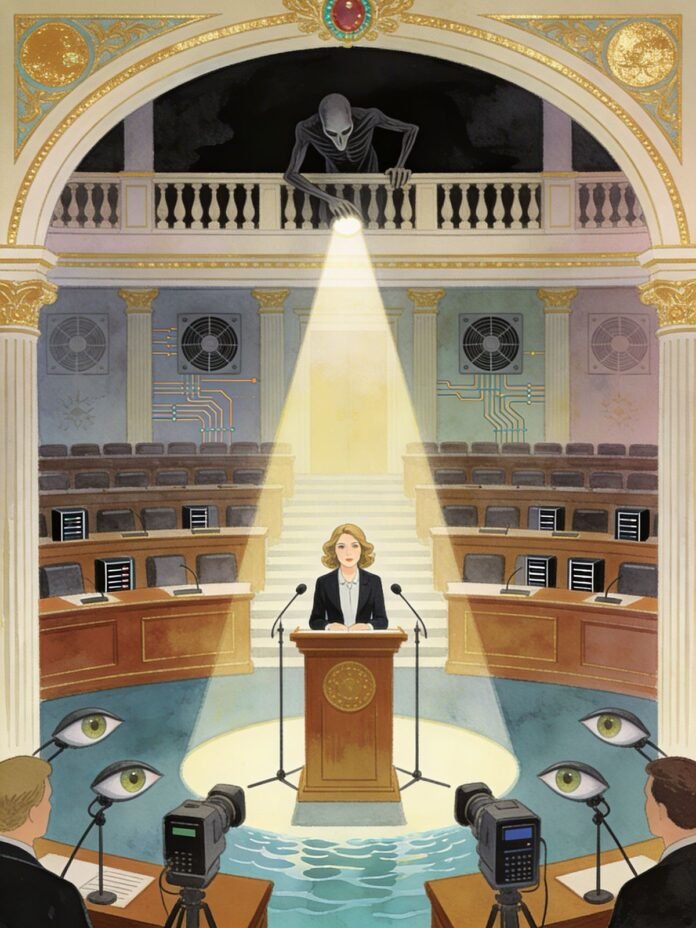
Moros’ corporeal form is an awkward tangle of too-long limbs and too-narrow hips, neither of which ease his drive through the congested streets of lower Manhattan. He quite enjoys the stench of diesel inside the sedan, all the more so with society’s absolution of fossil fuels. What’s the point when even their eco-friendly alternatives come with hidden costs like indentured labor and thermoelectric power?
There is a chorus of honks; a litany of swears; a traffic cop pointing to delayed lights and barking, “It’s out of my hands!” Yes, there is absolutely no point, he relishes with glee.
Moros has no qualms about masquerading as a human. Unlike the gods before and after him—and there aren’t many before— Moros prefers witnessing man’s folly up close. Even after all this time, mankind’s sorrow is an indulgence thicker than ambrosia.
Of course, there are other perks to omnipresence. He can jump from shadow to shadow in his quest for entropy. Each story becomes a card in his Rolodex of memories, fit to entertain whichever whimsy overcomes him next. He is often asked if he tires of the endings. His answer is always the same: There is no conclusion sweeter than inevitability.
Moros joins the fleet of cars merging into the Holland Tunnel, bumpers pulsing red in the Styx-like fog. In hindsight, he could’ve taken a shortcut through Hell and deposited himself in Secaucus. But where’s the fun in that? Besides, there’s nothing like inhaling the city’s foul perfumes: lonely millennials too estranged from reality to exchange furtive glances; gentrifiers encroaching on Staten Island in the face of soaring rent; multivitamins cheaper than fresh produce.
Despair. A natural byproduct of higher entropy. And yet, it never fails to send a shiver up his spine.
The afternoon sky is occluded by a collage of jumboscreens. Thank goodness for the guardrails in each lane, which roll vehicles safely along like conveyor belts, their drivers too busy consuming adverts for investment apps and androgynous couture. On either side of the road, he finds bodies curled on patches of snow, their eyes glazed over their empty mobile screens. Public servants nail boards over mom-and-pop shops. All the while, pockets of civilians march in circles with their drums and shakers, stirring up a ruckus for those who can afford to escape the perpetual smog.
While Moros enjoys this scenic route, he would be remiss to neglect the purpose of his trip. And that is to seek the woman responsible for his potential downfall. Yes, even gods can suffer at a human’s hand. As the literal embodiment of Armageddon, it should be nigh impossible for anyone to conquer him. But accidents happen, especially when oracles attempt to tamper with fate.
He rolls down the window and takes a big whiff of river brine. He follows the scent to the suburbs of northern New Jersey, where three-story homes rot along cul-de-sacs. How strange, Moros thinks, that in their pursuit of gilded streets, these mortals ultimately settle for the ordinary and mundane.
Even then, a lifetime of stasis is never guaranteed. They remain helpless to the rise of concrete slabs with their cloud servers and cooling turbines, chipping away at what little remains of municipal water. Now, these data centers overtake acres of land just beyond the pines, not unlike a military base.
Moros follows the thrum of machinery to a modified home. The dweller has taken great care to fill every threshold and sill with acrylic and board up the windows with soundproof panels. Yet, the rest of the property is in disrepair: water-stained shingles, rusted gutters, a chipped fountain, and swaths of turf-torn dirt.
Of particular note are the news vans loitering on the front lawn, their satellites spinning for covert frequencies inside. Moros would rebuke the production teams for peeping through mouse holes, but instead, he is drawn to the monitors inside the vans. They play asynchronous streams of a chamber boasting of Congressmen, their fists pounding like gavels on tabletops, arms gesticulating furiously. Nuclear facilities are overlaid with the amorphous spirals of startup logos.
Moros licks his lips. The Great Calamity is off to an excellent start.
“Hey, you can’t be here,” one journalist says. He puffs his chest in full press regalia, nose turned up at the apparent civilian. Moros doesn’t mind, of course. He isn’t particular about his human skin like the rest of the pantheon. No, a plain T-shirt will do. And let’s not forget a pair of aviators, lest his interlocutors witness an apocalypse from his gaze alone.
“Is she inside?” Moros asks.
“No, shit. She thinks she’s too good for an interview.”
The footage cuts to a woman taking center stage. She faces her audience with a coolness that belies the severity of her pale eyes. This is someone who has foretold and witnessed epic wars, those battle wounds tucked away as tightly as the iron-pressed edges of her blazer.
A sliding caption introduces her as the esteemed multi-hyphenate Dr. Cassie Vasilis, physicist-statistician-environmentalist. The broadcast enumerates her accolades, followed by rolling credits of previous testimonies on power plant regulations and clean air policies. She is, without a doubt, a worthy expert to pace America’s footing in the fourth Industrial Revolution.
“Do people actually care for this?” Moros asks. “This country has been running on nuclear power for decades now. I don’t recall anyone complaining then.”
“See over there?” The journalist steps out of the van and points at a throng of protesters gathered by the data center’s gates. They’re seemingly unperturbed by the guards pointing their weapons from the panopticon. “They smell like shit. Can’t even blame ‘em— haven’t had running water for weeks. And the ones over there? All had hours cut because AI does the job faster and cheaper.”
“I see. It won’t take much to defund the facilities then.”
“After Vasilis’ testimony? Those companies outta file for bankruptcy.”
Moros smiles. It’s just like Cassandra to intervene when the Great Calamity is starting to show promise. He wonders what’s so different about her upcoming prophecy. Does her heart soften for mankind’s plight, or is it all for the love of the game?
In any event, a brief visit ought to set matters straight.
*
Dr. Cassandra “Cassie” Vasilis has three hours to scarf a protein bar, slather her face in foundation, and board a plane for Washington, D.C. Instead of tackling any of these items, she stares at congealed menstrual blood in her urine. She wonders if the fill valve will break this time, as water swirls down the toilet drain ever so slowly. She recalls the bathroom stalls around Los Alamos, warning toilet paper enthusiasts that their historic buildings also come with historic plumbing. Reasonable, as their pipes must overcome a gradient of thousands of feet above sea level. As for New Jersey…
Dr. Vasilis sighs. Just another day of being a neighbor to the nation’s largest data center. At the very least, she is close to doing something about it.
Dr. Vasilis doesn’t maintain the loveliest of homes, but everything is arranged exactly how she likes. The walls are covered with empty canvases for scribbling theories and the occasional grocery list. A Linux computer boots up in the corner of the living room. Paperbacks live in various stacks in accordance with the Dewey Decimal System. And where would she be without her record collection? Nothing brings her greater joy than Greece’s Eurovision entries.
She rips charcoal strips from her teeth as she strides down a corridor. Her heels dig into frayed carpet, one snagging on a loose thread. She catches herself just in time to see a stranger in her kitchen.
He is the frailest man she has ever seen. His wrists look like they will collapse beneath the weight of her teacup. As he tilts his head back, a glimmer of sunlight bounces off his cheek, where she sees the translucent plateau of his zygomatic bone. He appraises her in kind, lingering on the lion’s mane adhered to her scalp, copper curls slick with olive oil.
“Hello, Cassie,” he says, kicking her own chair out. “Please, sit.” He passes her the same cup he sips from. Their fingers brush faintly enough for her heart to plummet to her stomach.
She envisions every tragedy she has ever foretold, amalgamating in her mind like the tangled knots in his lashes. A subzero election evening in North Carolina, snow seeping between her toes as voters abandon poll sites at sunset. The collapse of entire garment districts in South Asia, hellfire licking at child laborers whose mothers subsist off their earned pennies. Sharp arrows tearing her brother’s jugular like papyrus, blood staining her chiton red as he gurgles for forgiveness. Whispers of sorrows and regrets. She resists the pressure in her sinuses and the burn in her eyes. Instead, she chants silently: go away, go away, go away.
“Best not to dwell on it,” the man says.
He is not mortal. That much she knows. But his immortality contains a body and depth that far outnumber her own centuries walking this earth. Dr. Vasilis considers, briefly, if he is cursed like her. But his languid smile, chronic as the mark of priesthood on her nape, suggests otherwise.
Where has she seen that smile before?
“Don’t you recognize me?” he asks. “Maybe this will help.”
The air ripples like a moss-eaten veil. Reality splits for a handful of seconds, enough for Dr. Vasilis to glimpse his many forms: a storm cloud hovering over calciferous towers; a knight decaying upon a pale stallion; and finally, a looming god wrapped in midnight himation, waiting patiently atop Mount Ida.
Of course.
“You’re early,” she says.
“Did you miss me? No? Well, that’s okay. I understand. No one prays for doom, do they?”
Likely not, she thinks with a scoff. But what about his absolution? Her prayers in this field are unmatched, one echo after another in his altar’s chamber. Perhaps this is why he keeps her hostage with such ease; his arrival is, in fact, a homecoming.
“Why are you here?”
“Can’t I visit an old friend?” he asks.
“Are you going to sabotage my hearing?”
“I haven’t sabotaged anything. You, on the other hand…”
Dr. Vasilis didn’t always disdain the gods. It was so contrary to her identity, once renowned for her piety. But her rage has long simmered past its boiling point. No matter. Moros tends to handle her moods well.
She wonders if this is still the case as he stands abruptly. She follows him to the living room, breath caught between her teeth as he plucks a bouzouki off the wall.
“Do you still play?” he asks before strumming. The notes wobble clumsily, untuned.
“If you’re here to mock me, please do so quickly. I have a plane to catch.”
“You mortals could learn a thing or two about respect.”
“I agree. Alas, I don’t see any in this room.”
He picks a lazy strum, a meandering to and fro like wheat fields beneath the Aeolian winds. “Let me tell you a story.”
He quickens the cadence, foot tap-tap-tapping on a yellow book missing its cover. “Every fortnight, three sisters gather at Death’s door for a tea party. They exchange stitch patterns and discuss their projects over scones and Lethe-tea. ‘How many years do we drag out his cancer? Wouldn’t it be interesting if the couple got engaged at a funeral?’”
Dr. Vasilis never thought she would hear the god of doom pitch his voice so high.
“Now, these goddesses like to keep busy,” Moros continues. “Their hands are always weaving and snipping. This time, they’re knitting a sweater.”
“What kind of wool?” she asks dryly.
“Human hair. Yours, in fact.”
“Oh, how lovely.”
“They’re very good at their craft. So, imagine their surprise when they come across a snag.”
She shrugs. “Happens to the best of us.”
“Not to them. Do you know what a blip entails?”
Dr. Vasilis glances at the clock. Those three hours have dwindled to two.
“I’m sure you’ll tell me.”
“Humanity approaches the cosmic limit. Maximum entropy. An apocalypse outside the rules of my playbook.”
“Seems like a fragile system if one event can topple an entire order.” Or lack thereof, she thinks. But she would rather keep her head on her shoulders.
“Do you believe in coincidences, Cassandra?”
“No, I don’t.”
“Good. So, we can both agree that this is a charade. You pursuing a doctorate, garnering repute as a climate activist, just when you’re scheduled for a prophecy?”
Dr. Vasilis presses her lips together. She does not owe him an answer, not when he can work out the details for himself.
“Did you think your plan was going to work?” Moros asks with an ugly sneer. “That you could just dress up your prophecy as a testimony? Singlehandedly usurp the Great Calamity by manipulating your audience?”
“What would you have me do?” She keeps her voice steady, devoid of the emotion that cost her countless battles with gods and men. “Allow nuclear plants to scale with unchecked power? Say nothing when those reactors are destined to explode?”
Beneath his glasses, his eyes glow with the mushroomed plumes of nuclear radiation, decimating entire continents, leaving no more than a family of cockroaches choking on sulfur. She can only bask in his fervor with equal measures of disgust.
“Why are you doing this?” he asks.
Dr. Vasilis wants to reach into her arsenal of rebuttals. She wants to prevent mankind’s annihilation. She could rise to the legion of heroes praised around campfires. But there’s no use in lying to Moros. He already knows what’s in her heart.
“The Hellenes never believed ‘Cassandra of Troy.’ The masses certainly won’t believe her today. But they may believe a renowned scientist.”
He laughs then, his molars pressed against thinning skin. “So, all this time, you were searching for a loophole?”
She smiles thinly. Yes, laugh, get it all out.
“I once vowed celibacy in the service of the gods. And how does Apollo repay the favor? By cursing me to sprout prophecies ’til the end of time. To an unwilling audience, no less. All because I refused his advances. But now? Now, I can reclaim my life.”
Surely the gods know she has worked long and hard for this. It’s no easy feat to run the herculean gamut that is the American education system; to publish transformative research on geoengineering; to engage global communities on sustainable climate intervention. Her body is now a machine, inhaling the intricacies of her prophecy and exhaling a manifesto that touts the interconnection between water shortages, job insecurity, and unregulated technologies. And today, that labor bears fruit. The entire nation will tune into the televised hearing, hanging by the edge of their seats as the House challenges the president’s militant nuclear expansion.
Moros’ presence alone should suggest that she is close; the scales are finally tipped in her favor. And yet, he manages to unravel her with a few choice words.
“Your defiance isn’t by design.”
How could he possibly understand the true pain of immortality? He gets to play human for a day, while her infinite lifespan remains imprisoned in mortal flesh. Moros will never carry the memory of Apollo’s tongue laving her tears as flames consumed the citadels of Troy. He would never know the waves of ecstasy forced upon her with each prophetic verse, a constant reminder of just who she rejected.
“Of course,” she says. “Your will remains undefeated.”
She holds his gaze, transfixed by the everlasting embers beneath those lenses.
“It must be nice being Apollo’s puppet master,” she continues. Dr. Vasilis knows she is playing with fire. But Moros lit the match. “You even fooled him into believing I was his marionette.”
“I’ve warned you about misplacing your anger.”
“You control fate. Everyone’s a pawn to you, humans and deities alike. The least you can do is take accountability.”
“Need I remind you? I only see the end of time.” His tone is suddenly clipped, frigid. “That is the nature of my will, of inevitability. I will not be held liable for the evil lurking in Apollo’s heart.”
“And yet,” she argues, because that is in her nature, “it’s your will that compels him.”
“I’m clearly wasting my breath,” he says bitterly.
“Why bother coming all this way, then?” she asks. “The Fates already warned you that I’d be a problem. So, why not reverse the blip? Make it so I fail again?”
“Because I can’t!” he snarls. The walls quake in his anger, furniture unspooling from noxious fumes. She flinches as wooden beams splinter. The china cabinet shatters into glass fragments. “You’ve stolen the reins, Cassandra. The apocalypse hinges on your will. And once everyone realizes that destiny can, in fact, be conquered, they will no sooner witness my fall. And there are many opportunists.”
She swallows thickly. “The king of the gods—”
“Will finally have power over me,” he finishes.
Standing among the ruins of her home, she realizes Moros only has one solution to ensure his calamity. And that is eliminating the root of his threat.
Her.
She is sure mortals have been smote for less.
These thoughts must flit across her expression, because he chuckles deep from his chest. “I let you live because your persistence amuses me.”
“Thank you,” she murmurs.
“Will you consider changing your mind?”
She cannot meet his gaze anymore. It will scald her before she reaches the Capitol’s podium.
“My purpose is too great,” she says, regrettably.
The tightening of his lips tells her she has crossed a line. Dr. Vasilis squeezes her eyes shut, awaiting the simultaneous push and pull of her innards. But a moment passes, then another, and when she squints with one eye, she sees he is gone.
*
There is an art to prophesying that Dr. Vasilis has lost over time. The practices she once kept as a priestess elude her in a modern world that frowns upon animal sacrifices and bloodletting. Instead, she squeezes a drop of cannabis oil beneath her tongue and prays she doesn’t make a fool of herself.
Her calves burn as she pivots over cobblestone. The staffers do not spare a moment, not when her late arrival is unconscionable to a room of Congressmen negotiating since dawn. Dr. Vasilis, of course, doesn’t apologize. She is sure to captivate them at any hour.
She flattens herself along the chamber’s narrow aisles until she finds the placard with her name. She is touched to find no other seats beside her. The stage is hers alone to command.
She no longer flinches at the cranked spotlights nor the lapel microphone’s screech. She’s indifferent to the makeup brushes on her face. She’s much too transfixed by the contents of her briefcase, scores of filings that trace nuclear disasters and supply chains.
The Congressmen chat among themselves, asking how so-and-so’s kids are doing, if their upcoming memoir has found a publishing house yet. They’re saving their theatrics for the viewers tuning in. That’s fine. Dr. Vasilis can finally relax as ghostly apparitions massage the knots in her amygdala. Because this time, she won’t have to fear the euphoric afterglow of her prophecy. She simply knows, in her heart of hearts, that mankind is already embodying society’s collapse, their souls primed to shoulder this doom with her.
A teleprompter loads.
A projector counts down.
They go live.
*
Numbers roll off her tongue with ease.
Dr. Vasilis articulates the unfettered demands of vertical AI agents, which threaten to replace search engines the way they did manual directories. She maps their upkeep to the proliferation of data centers and the correlating drain on global reservoirs. In fact, many towns have shut down as a result, including some that these Congressmen hail from. And as attractive as the Fission Works Proposal is—a sustainable swap from water-driven LLMs to nuclear-powered ones—the exponential output from these reactors will push society toward a chemical apocalypse. Don’t trust her; trust the statistical models, the same ones that foretold the rise of AI.
The Congressmen, who typically slumber at this point, lean forward with pale knuckles.
She feels no ecstasy.
Projected images flicker across somber faces, their handkerchiefs damp at the footage of children tucked inside bunkers while reactors collapse all around.
Still, she feels no ecstasy.
“We can prevent this,” one representative cries.
“What if we lag behind?” another languishes.
But her counterarguments are ironclad. And if they still have doubts, they can redirect their focus to a series of questions. Is their country prepared to foot more labor hours to correct non-human errors? Are companies willing to surrender their reputation to the hands of machines? Can America contend with a new form of currency: not crypto, not jewels, but water itself? She is met with murmurs of contention.
This is it, she thinks. This is the sound of tides turning.
And yet, she feels no ecstasy.
The cameras burn her pupils, scarlet dots curling like leeches with each blink. She cannot look away, not when the nation is bewitched by her testimony.
But if that were true, why couldn’t she feel the prophecy? She’d done everything right.
Perhaps there’s a delay. Perhaps her body has acclimated to the slow assault of adrenaline that stakes claim to her body. And now she is finally numb.
But are things ever that simple?
That bastard must’ve intervened.
She skims over the chamber’s crevices, searching for those scrupulous eyes under Aphrodite’s trance, because nothing brings him greater desire than the precipice of shame. She finds his lanky arms sprawled across the balustrade. His eyes are indeed burning. But there is something more. A quirk of the brows and a question on his lips.
The representatives are a sea of yeas and nays with their paddles, so bright they’re impossible to count. She starts over, again and again, until the scoreboard beats her and fills every monitor.
The ensuing silence is unbearable, split only by a wheezing cough and the creaks of wooden benches.
Still, she gives it a moment.
Then, another.
*
Moros finds her at a bar on The Wharf. There’s no better place for her to hide after putting on a stellar show for the federal circus.
This is the Cassandra he knows. Shoulders tucked back, head lolled to ease the crick in her neck, hair dipping into another man’s beer. It may not be the classical beauty that Apollo lauds in his sonnets, but Moros thinks he begins to understand.
He weaves around the patrons, plucking bits of food to assemble a meal for her. She watches with half-lidded eyes as televisions cut away from a soccer match to the evening’s segment. This just in: Congress votes to dismantle Fission Works. Funds will be pulled from the President’s latest installments of modular reactors and data centers for the foreseeable future.
“I believe congratulations are in order,” Moros says.
Cassandra sits upright and gathers her hair over her clavicle. She sniffs the split ends and grimaces. “It’s temporary.”
“Is it now?”
“Just wait until the House majority shifts, or the next low-carbon scheme comes along. They’ll repackage this however long it takes for mankind to annihilate itself.”
“Very true. But that’s not why you’re upset.” He slides his fingers between her locks, drawing the moisture out.
“No.” Her tone is no longer defensive. She holds her glass out, and Moros obliges with a simple wave that replenishes her wine. “I know the world will have to come to an end. I just thought I’d break his curse before it all went to shit.”
“If it’s any consolation, I thought you did.”
Had it been anyone else, Moros would’ve taken credit for the turn of events. Of course, this wasn’t your prophecy; it’s just as I divined. But Cassandra would see right through his lie. After all, he made no real effort to conceal his surprise when the testimony failed to resonate with a prophetic spark.
“The degrees cost a lot, you know,” she says.
“I’m sure. Do you need a loan?”
Cassandra snorts into her glass. “If you can spare a couple of drachmas.”
Moros is glad she doesn’t belabor him further. In truth, he doesn’t understand it himself. If her testimony isn’t the blip, then what is? His sisters seemed so sure when they revealed their stitch pattern of Dr. Vasilis at the golden podium.
Suddenly, his shoulder feels warm. He looks down, startled to see Cassandra cooling her forehead against his leather-clad arm. He sighs, deciding to stay put. While Cassandra is far from being his champion, he can admit the toll she underwent. Although he likes to think he toils just the same. She is, after all, the only woman he crosses realms for so frequently.
As demure as she is about her success, however short-lived, patrons all around are elated by the news. Every quarter hour rings in a round of shots. Under the guise of inebriation, strangers joke they can barely work self-checkout stations, let alone AI chat boxes. Others point out the suspicious timing of AI proliferation and the growing gig economy, leaving countless without employer-sponsored health insurance. For all their talk of ease and modernity, it sure feels like the government is leaving out the little guy.
As their conversations give way to silent contemplation, Moros drinks his fill of fear and uncertainty. He thinks he may even get drunk. His only buoy is the woman beside him, sipping away with an inscrutable veneer.
“What are you thinking?” he asks.
“You believe destiny is impartial.”
“It is, yes.”
“How do you avoid bias?”
“That’s easy,” he says, without giving it much thought. “You cease to care. The rest follows suit.”
“What happens if that were to change?”
“I’ve never had that problem,” Moros says dismissively.
“But what if?”
He looks out to the left wing of the bar, where stools are being arranged for a poetry open mic. When he glances back down at Cassandra, he notes her skin has turned to gooseflesh. A faint flush works up her neck.
“It would be our undoing.”
He can see his sisters clearer than ever, their white gowns doused in sweat as they needle past the snag. When he looks back to the woman at his shoulder, he spots a golden halo over her head. But light from a singular bulb shouldn’t bend this way. Not when it softens her freckles and the curve of her mouth.
Oh.
This is not good.
If only his sisters had spared him their riddles and simply pointed their fingers at him.
“You should read your poem,” Moros says.
Cassandra runs her finger over the rim of her glass, head tucked to conceal her prickling tears. “I didn’t come prepared.”
“You’ll do great.”
She draws her arms to her stomach, resistant, at first—but the moment has passed.
She stumbles to her feet and wipes the perspiration from her lips. Whoops and cheers follow as the first brave fellow braces the stage. She riffles through her purse and withdraws a crumpled sheet of paper, unfolding it with care. They both know there’s nothing written on the other side.
Her soft exhale, so full of dread and compliance, is music to his ears.
Capital will flow through ones and zeroes,
As unicorns mine markets like unforeseen heroes.
The masses consume clutter for days and days,
Cruising along information superhighways.
Moros lowers his glasses, unwilling to have his view obstructed. As her curls tumble over her hips, he realizes that he prefers Cassandra this way, poised yet unapologetic.
But like all bubbles, this will come to a pop.
Investors will discover the ultimate sunk cost
Of rushing machines to the assembly’s top,
While the masses wallow in icons lost.
Patrons steal glances at their phones; others pen their own stanzas. While Moros is rarely overcome with wrath, he can make an exception. He inverts his palm. No sooner do batteries drain and ink cartridges evaporate. Now, they have no choice but to witness their oracle.
No one is safe from the swinging axe,
Whittling away the creator’s bone lax.
Spokes on man’s wheel fall apart
With light and color spilling from the heart.
They shuffle in their stools with an itch beyond discomfort. No one wants to linger in her words, not when destiny treated them so kindly today.
Try as they may to breathe their souls
Into icons once thought to be lost for good.
Lighting will no longer strike the shoals
That traded their minds for rotting wood.
Cassandra finally meets his gaze. It takes him a moment to realize she holds no contempt. No, it’s quite the opposite. She seeks him out like an anchor in blistering waves, lost to the lines clipping over her microphone.
Little do they challenge their compulsion for tools,
Content with banality like insipid fools.
Moros cannot give Cassandra the world, but he can give her this moment: a crowd of snapping fingers.
He doesn’t mind if she runs off after this.
Be it the next hour or the next century. He will see her again. It is inevitable as the end of time.


