

NEW YORK
New York Fashion Week was born out of a profound absence. In 1943, with Paris under occupation and American editors cut off from the French collections they had always depended on, publicist Eleanor Lambert gathered the press for a “Press Week” to prove that American designers existed in their own right. With this, they successfully proved their existence separate from the french designer community. Paris sold the rarefied dream of couture: hand-built garments for a few thousand women of fortune and lineage, policed by the Chambre Syndicale and wrapped in centuries of snobbery. New York sold practical, wearable clothes. It offered separates, sportswear, and the easy, everyday wardrobe of a country that worked, commuted, and bought off the rack. Its audience was not the aristocrat in a gilded salon but the department-store buyer from Saks or Bloomingdale’s with an order book, the editor from Vogue or Women’s Wear Daily with a deadline, and, behind them, the vast American shopper who would eventually wear whatever survived the season.
Herein lied and continues to lie, New York’s superpower. Seventh Avenue became the shorthand for an entire industry, and by the time American big shots like Calvin Klein, Ralph Lauren, and Donna Karan had made their names, New York held the opening slot in the month-long relay that ran on through London and Milan to Paris. It was the first verdict on what the world’s largest luxury market might spend. The 1973 Battle of Versailles, in which Halston, Oscar de la Renta, Bill Blass, and their colleagues outshone the French houses on French soil, made this point with confidence. When the shows moved into the white tents of Bryant Park in 1993 (where NYFW is currently housed), they became a civic spectacle and a week in which celebrities and ordinary you-and-me thronged alike. Its politics, for the most part, dominated the politics of commerce. Whatever else it was, New York Fashion Week was a trade fair for an industry that believed it was the center of the world, and for decades the evidence was on its side.
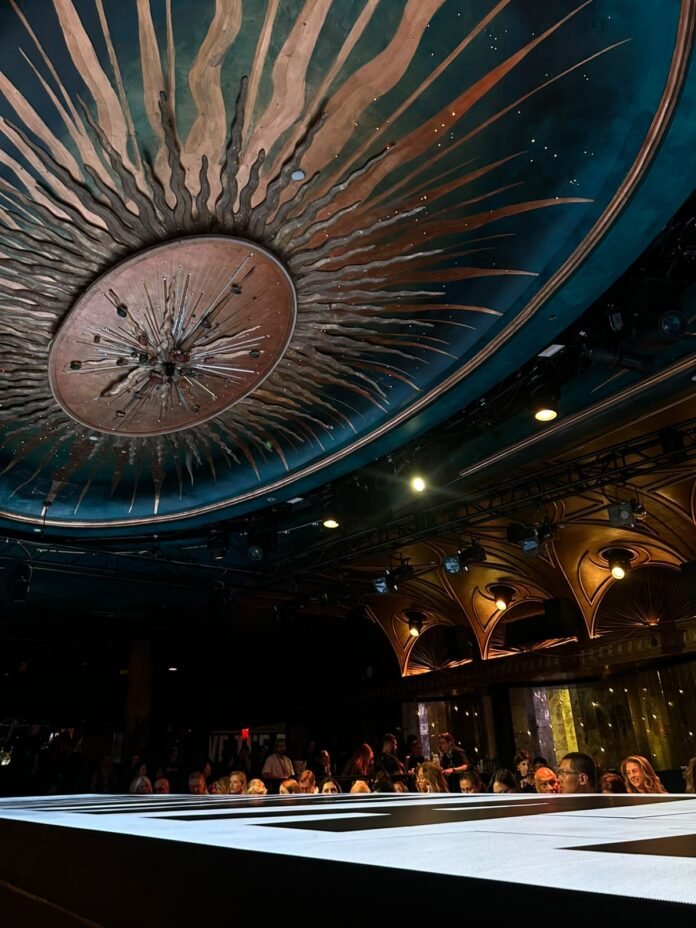
Today’s New York Fashion Week however, paints a starkly different picture. ZIAN, a label based in Buenos Aires, showed fitted black silhouettes, exposed backs, heels, and leather accents while a Vancouver based designer, Neelam Sami, worked with florals, draping, and varied textiles. Chile’s Linaje Atelier mixed tailoring with reclaimed materials and House of Apaala turned to denim, colour, and playful styling. The designers came from different places and worked in different visual languages. And yet, what remained most noticeable was the fact that there was
However, this space for creative exploration has also been seeing its fair share of trials and tribulations. The city’s fashion industry has lost roughly 50,000 jobs over the past decade, according to McKinsey. Inflation adjusted economic output has fallen from earlier highs. At the same time, designers now move more easily between New York, Paris, and other fashion capitals. A look at social media buzz and general fashion communities will easily reveal how some American labels now no longer regard New York as the de facto place to present a collection. This marked decline in popularity raises questions that still need to be deliberated upon.
The official calendar for NYFW however, has not disappeared into irrelevance. This September, it included 70 runway shows and designer presentations, along with collections shown digitally or by appointment. From big house names such as the Calvin Klein Collection, Carolina Herrera, Michael Kors, Proenza Schouler, Tory Burch, and Thom Browne who remained on the schedule to Tommy Hilfiger, Monse, and threeASFOUR that have returned. The result is a Fashion Week that looks less dominant in terms of the staple, big fashion names, than it once did, but also one that looks more exciting than ever before. This was clear in the four collections shown that evening. Argentinian brand, ZIAN’s work was sleek and metropolitan. Its cultural identity was not presented through obvious national symbols. In fact, even the clothes did not seem interested in explaining where the designer came from. At a time when designers from outside the traditional fashion capitals are often expected to make identity visible in immediately recognisable ways, either to forward a certain internal agenda or theme with regard to nationalistic views, this felt pleasantly refreshing.
Linaje Atelier approached the ramp quite differently. The Chilean label uses reclaimed garments and textiles, turning existing material into one of a kind pieces. On the runway, tailored garments appeared alongside unexpected fabric combinations. Some looked as though they incorporated repurposed ties. The presentation carried a stronger sense of Chilean context, even while still avoiding the obvious national shorthand. Both labels adequately represented their origins in a way that felt unforced and enough to foreground the audience’s attention on the specific clothes presented on the runway.
The freedom of diversity and expression has become more important as fashion becomes increasingly international. Runway images now travel almost faster than the models themselves could make it home. Designers, consumers, stylists, and editors can watch collections from several countries in the same afternoon. The speed of that exchange has widened access, but it has also made aesthetic repetitions a lot easier. The same references circulate quickly, as seen in how often successful silhouettes appear in several markets before a season has ended.
New York’s usefulness amidst this problem lies in resisting that very sameness.
The four collections did not resemble one another, and it almost feels like a conscious effort was made to fit them into a shared visual identity. Argentina appeared beside Canada, on the other hand, Chile appeared beside a South Asian diasporic perspective. A fitted black dress could be followed by florals, reconstructed tailoring, or denim. The connection between the collections was less stylistic and more highlighting the diversity of the city itself in which they were being presented.
For much of its history, Fashion Week has been judged through power. Which city had the strongest houses? Which calendar drew the most attention? Which runway could set the direction of the season?
Those questions are still as relevant as ever. New York’s fashion economy faces pressure, and emerging labels cannot simply replace the financial or cultural reach of established houses. The movement of major designers between cities is also a phenomenon that changes how much authority any single fashion week can claim.
The relevance of New York Fashion Week quite possibly rests in the way it tells the global fashion industry what fashion itself should look like. Not in terms of the collections or style itself but because designers with completely contrasting visions can still arrive and present on the same platform, catering to the same unified but also diverse audience.
While we are aware that just four collections can hardly establish the future of New York Fashion Week through its diversity and vision, we are more intrigued and excited about how they can show what a version of that future looks like.

Our mascot writes all ALMA Staff pieces. ORI is whimsical and unpredictable; we’ve tried being friends with him and failed.


