



After setting out from the Arctic Ocean, the number one question I was asked en route from Alaska to Argentina was: “How are you getting around the Darién Gap though?”
This sparsely governed expanse connecting Central and South America comprises what Outside Magazine calls “the world’s most dangerous jungle.” There are no roads, merely social trails predominantly utilized by a migration upsurge that’s steadily ballooned from an average of fewer than 11,000 crossings per year during the previous decade to over a half million in 2023, according to the Migration Policy Institute. The International Federation of Red Cross and Red Crescent Societies, the world’s largest humanitarian aid network, documented that between 2018 and 2023, 258 people died crossing the Darién. The Council on Foreign Relations explains: “Many pay to be led by local guides, or ‘coyotes.’ Along the route are smugglers and criminal groups, including members of the Revolutionary Armed Forces of Colombia and the Gulf Clan, a paramilitary group and Colombia’s largest drug cartel.” Jean Gough, then regional director for Latin America and the Caribbean at the UN Children’s Fund (UNICEF), added: “Deep in the jungle, robbery, rape, and human trafficking are as dangerous as wild animals, insects and the absolute lack of safe drinking water.” The Guna people primarily reside within three autonomous comarcas [territories]: Guna Yala, Madungandí, and Wargandí; Guna Yala, meaning “Land of the Guna,” stretches along Panama’s Caribbean coast and includes an archipelagic chain of 365 islands.
For most travelers, the easiest and fastest way around is by plane from Panama City to Bogotá, Colombia. I wasn’t too keen on disassembling my bike into a giant box again and dragging it across town to another airport, all the while keeping fingers crossed that it wouldn’t get crushed in the belly of a plane. Nor did it seem wise to try hiking my bike through the swamp below. Instead, I crossed the Panama Canal and turned northeast along the Caribbean Coast, where I met up with a Colombian engineer navigating his small Vagabond 47 sailboat to Cartagena. We lashed my bike to the mast and wrapped it in garbage bags to keep the corrosive rust of saltwater oxidation away.
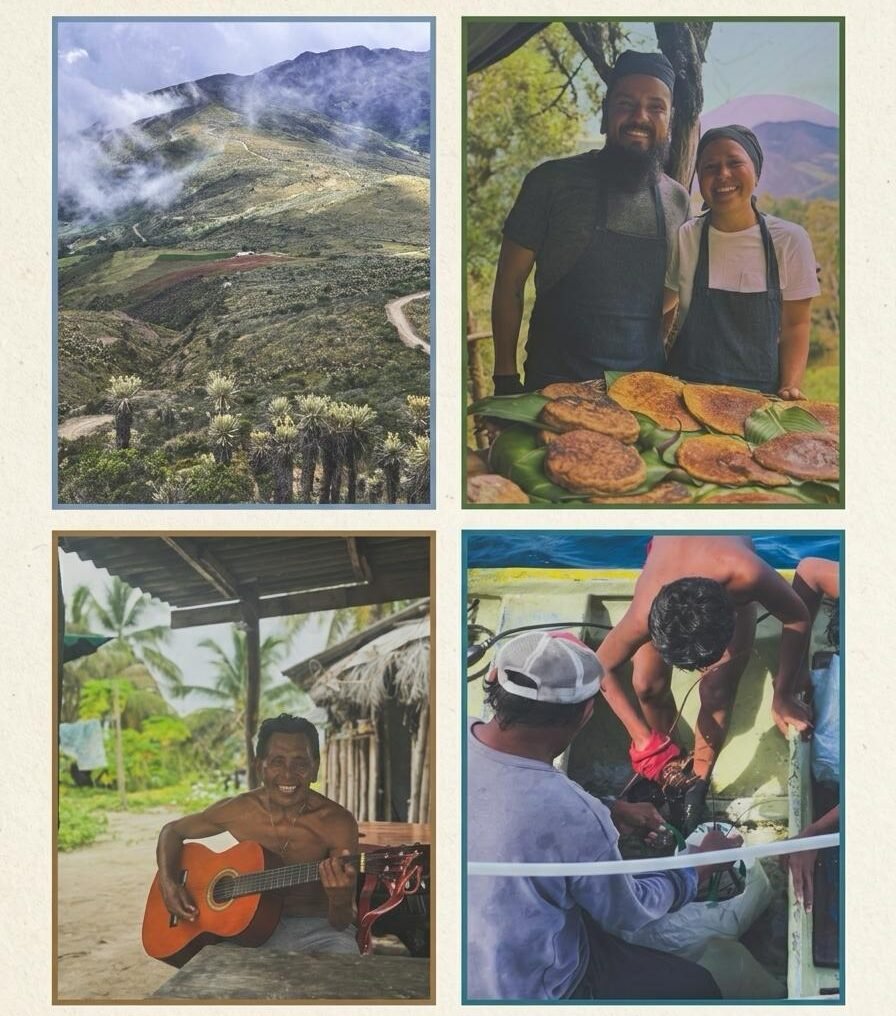
Sunsets here were not quite peach, not quite pumpkin, but something liquid and molten. Scant lights from scattered settlements hugged the coastline, where neighbourly captains played dominoes in the sand and utilized resident Starlink internet access to stream national fútbol matches together. Their boats bobbed softly in the distance, like bright plastic toys caught drifting in tranquil bathwater the colour of blue popsicles in the brute heart of summer. Virgin sandbars huddled together everywhere, and it took but a few minutes to walk their perimeter, driftwood collecting on their beaches with dried coconut husks and bleached fragments of coral. Nurse sharks patrolled the reefs that surrounded them, which, while technically omnivorous, are docile and opportunistic eaters. It was undeniably picturesque, not only for the whiteness of beaches and soft curvature of the palm trees; an entire community thrived where there was almost nothing at all, where just a few fledgling cays of the world’s finest sand marked an allowance for this remote society to keep their heads above water. The islanders were peaceable yet lively, bronzed by a life spent entirely outdoors, sidling up in small triangular skiffs to offer the day’s freshest catches of fish and lobster. Some of these islands are expected to face permanent inundation, and coastal communities may be forced to the mainland, becoming what the BBC calls: “Some of the Americas’ first climate change refugees.” Gardi Sugdub, the crowded island home to about 1,200 Guna residents, already faced their government-facilitated relocation to a repurposed Panamanian yucca field in 2024.
Despite its magazine-worthy panoramas, our ensuing ocean crossing was torturous at times, like trying to sleep in the front row of a wooden roller coaster for days on end, waking up midair at 4 a.m. when the waves were most vicious, all while roasting alive in a devilish heat with nowhere to hide. Then came the choked chaos of Cartagena, a staggering parade of pounding music and celebratory colour. Dense humidity draped across the shoulders like a weighted blanket, ripe with the fragrance of papas rellenas [gigantic potato croquettes], carimañolas and pan de yuca con bocadillo [fried cassava root flour stuffed with cheese or a not-too-sweet guava paste], almojábanas and aborrajados [a fried and savoury plantain pastry], arepas de huevo [stuffed cornmeal patties] and empanadas of all combinations. I stacked a week’s worth of consecutive 100-mile rides [160 km] along la Ruta del Sol, tracing the Magdalena River through Mompox and a suffocating heat index of 120º F [48º C]. Two gallons of water each day wasn’t enough, racing skyward for cooler temperatures in Bucaramanga and Colombia’s Cordillera Oriental.
Secluded gravel roads snaked between massive canyons and colonial villages of Boyacá Department toward a remote mountain town called El Cocuy and its namesake glacier. Andean locals wore ponchos and puffer jackets, though older residents sported traditional bowler hats and colourful shawls. Steaming cups of tinto were offered at every doorstep, an extraordinarily sweet thermos of black coffee. Glaciers loomed in a brooding foggy nebula, with rugged dirt paths peaking over 12,600 ft [3,840 m] before the rocky descent through Güicán turned my hands to stone.
For two weeks I climbed over 6,000 ft [1.8 km] in elevation each day, inching deeper and deeper into a hushed countryside that skirts the Amazonian border of Venezuela. South of El Cocuy came my first páramo, a plodding murmur of paradisaic wasteland and the highest bike pass of my cycling career. Alternating between loose rocky shrapnel and hard-packed clay, the pass crept just above 13,500 ft [4,100 m] to a neotropical high-altitude biome found mainly within the northern Andes. Alien frailejones towered against the mountainsides like something between lamb’s ear and Joshua trees. The Wildlife Conservation Society reports: “88 of these species live in Colombia alone, making the country the region with the greatest diversity of these plants.” Whipped ribbons of fog veiled the peaks in eerie silence, with the only signs of traffic being regional farmers on horseback or páramo deer leaping between rare flora. It was the first time I’d needed a coat since northern Canada.
The descents pushed my bike to its limits, burning through brake pads every two days and the delicate springs between them imploding faster than I could keep up with. In Chita, I asked around for a mechanic, eventually landing at Pedro’s informal tool shed. We hoisted the bike on a rope tied to his roof, combing through buckets of replacements with no success. He anchored an oversized pair of pads into a vice grip at the edge of his workbench and laid into them with a hand grinder, sparks ricocheting everywhere. It didn’t quite fit as we’d hoped, so I risked the rest of the way without them, jamming my shoe against the front tire in lieu of brakes when the road grew too callous.
In the next town of Jericó, I asked again for the nearest mechanic. One motorcycle technician had a neighbour who liked bikes, he said. Omar wasn’t a mechanic himself, but did offer a plastic cup full of secondhand parts. With complete shock, I found an unlikely match and continued onward in the familiar gold dust of cacti and sun-kissed canyons, racing south through Bogotá, Huila, Cauca, and Putumayo. Eventually I needed to cross over from the Tatacoa Desert corridor into an adjacent valley towards Ecuador.
There were only three ways across the mountains, each a +10,000 ft gravel climb with its own collection of poor reviews. I sought advice for days, showing maps to locals in small towns and asking which route they thought might be safest. Conflicting information came from all sides. One woman ran her finger along specific stretches of wilderness and whispered: “Guerrillas,” with a rueful grimace. A fellow bikepacker from Medellín advised: “No!” between Popayán and Pasto. When I asked why, he warned flatly: “Narcos.” News reports corroborated his cautionary tone, with erratic violence escalating all summer into a Cali car bombing by dissident factions of former FARC insurgents [the Revolutionary Armed Forces of Colombia, a Marxist rebel group] that killed six people.
Avoiding this area meant that my only option was a small dirt road that Colombians lovingly referred to as “the Trampoline of Death.” I had to laugh at the idea that such a place could be the safest choice. Its map looked more like a seismograph, with jagged spurs and blind switchbacks exploding in all directions. Those who knew of El Trampolín would whistle and recoil, rubbing their hands together as if struck by sudden chills. Landslides, mud tracks, and river crossings often closed the pass off entirely. Missing guardrails were haphazardly replaced by loose branches tied together with yellow caution tape.
I climbed without let-up until sundown, asking two women with a roadside restaurant if they knew of any safe places to camp. They walked me to a vacant schoolhouse nearby and in the morning invited me inside for restorative cups of tinto with arepas and hot soup. Their sweet abuelita [grandma] was the most talkative. She wore fluffy pyjamas day and night, methodically peeling plantains in the corner while shooing chickens away from her scraps. They wouldn’t let me pay for their hospitality, instead making the sign of the cross and wishing me safe passage ahead toward the border in Ipiales, the Las Lajas Sanctuary, and the Trans Ecuador Mountain Bike Route beyond. For all the outside alarm that preceded them, these were among the most gracious people I’d encountered between the Poles. I lost count of the many times they’d climbed down from their trucks and motorcycles to hand me food, water, or just the soft echoes of togetherness with an uplifting conversation.
