

At an ordinary hour on an ordinary night, drinking an ordinary cup of coffee and wandering through ordinary pages on the internet, I came across an extraordinary painter. Some encounters feel less like discoveries than jolts. My first encounter with Havva Malyalızade’s paintings was one of them. Something in me seemed to fall into place, though until that moment I had not known it was missing. The images glowing on my screen drew me beyond the story of an artist and into the uneasy corridors of a memory searching for a home.
Looking at the figure perched in Mouflon and the stairways beneath The Olive Tree, I found myself thinking of a sentence by Theodor Adorno: “Wrong life cannot be lived rightly.” But the paintings seemed to ask a question of their own: how can a fragmented memory find its shape in a world that has made it homeless? They also reminded me of Marc Chagall, whose floating figures seem free of gravity, carried aloft by love, dreams and the memory of home. Under the scorching sun of Cyprus, however, that weightlessness takes on a different meaning.
Malyalızade’s figures do not seem to rise out of joy. They hover because there is nowhere for them to land. The ground that should receive them has become entangled in questions of property, borders and belonging. Their suspension feels less like flight than an inability to take hold. In Chagall, floating is possible because the figures remain bound to home; here, it marks the pain of having nowhere to put down roots. Ownership and belonging become painfully different things: a person may remember a place as home without being allowed to stand on its soil. In The Olive Tree, the stairways promise movement, perhaps even escape, yet seem to lead nowhere. Above lies the suggestion of a paradise that can no longer be reached; below, the possibility of another exile. There are steps, and the desire to climb them, but no firm ground on which to stand. What remains is the dizzying sensation of living on a threshold.
My thoughts move from those stairways to Dowry, with its fifty-year-old traditional textile. In Malyalızade’s hands, the fabric becomes something like a second skin. It carries the touch of the past, but also the weight of inheritance: the rules about what belongs to whom, what must be handed down, and what a woman is expected to carry. Placed beside the silhouettes of the Mothers series, it suggests a line of women whose experiences have been pushed into silence but never erased. The poet Adrienne Rich wrote of a maternal inheritance that persists beneath the stories we are taught to tell. I can feel something of that inheritance in these paintings.
The female bodies Malyalızade paints are neither passive symbols nor forms arranged for someone else’s gaze. They breathe, sweat, desire and strain against the limits placed upon them. Those limits include the roles women are expected to perform, repeated so often that they begin to seem like nature itself. Yet these figures suggest a self still in the making, one that cannot be fully contained by those roles. Their curves and the textures of their skin hold a will to live, but also a weariness that words cannot quite express. Here, a body has its own history. It is a map of pleasure and pain, a geography in its own right, an undiscovered country. The closer I look, the less I feel that I am observing a body from the outside. I am being invited into the brief, unsettling intimacy of a body speaking in its own language.
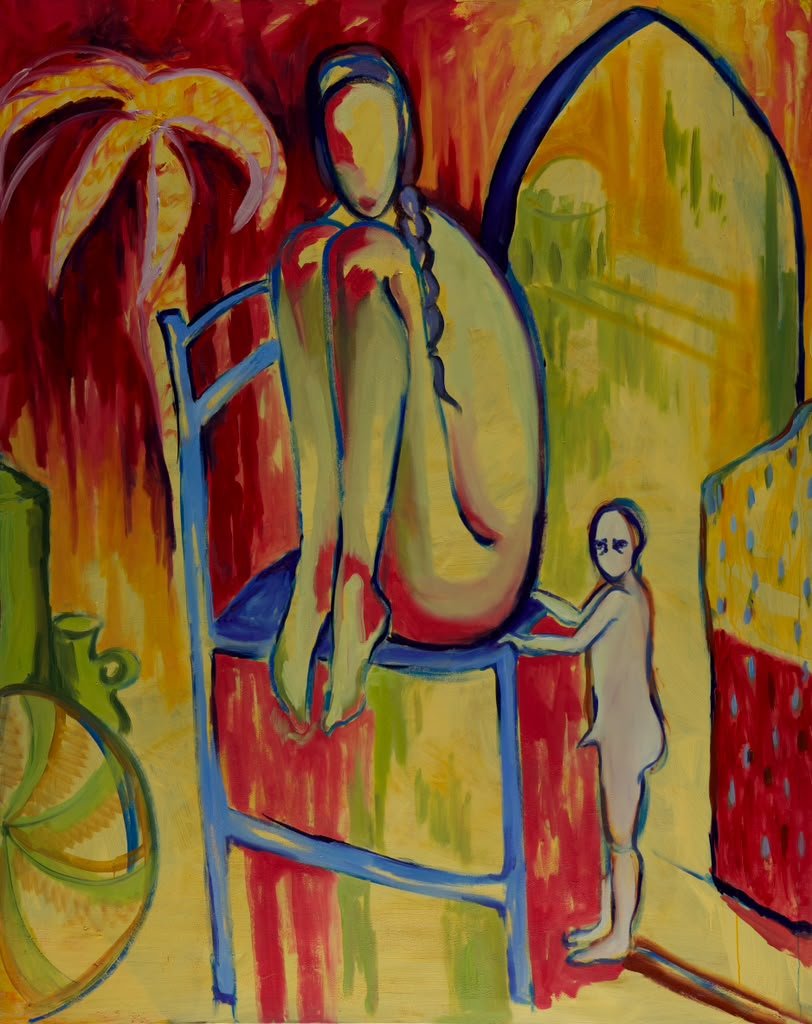
250cm x 200cm
Oil on canvas
There is anger in these paintings, too, though it is wrapped in elegance. I sense it in the still, uncanny waiting of the figures in Hugging the shadow underneath the umbrella and again in the labour pains of Giving birth to a girl. That anger reaches beyond the Green Line dividing Cyprus. It belongs also to a longer history in which women have been made to feel like strangers to their own bodies and lives. Yet I do not see anger here as an end in itself. It is part of the struggle to remake a self from what has been damaged. In A Ghost of a Child, the past enters the rooms of the present. Across these paintings, memory seems unable to return whole. A memory shaped by colonisation may need to break apart before it can reveal the truth that a seamless story would conceal.
Why, I keep wondering, does this unfamiliar world feel so close to me? Why does seeing these paintings for the first time feel more like watching long-dormant images awaken in a hidden corner of my own mind?
I know the feeling. Since childhood, certain books, songs and films have reached me in this way, stirring something I could recognise but could not explain. Now colour has done the same.
Perhaps we each carry a fragment of a larger human story, and art sometimes finds that fragment before we do. Malyalızade’s paintings release me, for a moment, from the boundaries of being only myself or only a stranger. I find myself embracing the story of displacement in her palette as though it belonged to my own childhood, to the lost homeland I carry within me. I have little doubt that she is one of those artists one meets only rarely. The melancholy wrapped in grace and the elusive happiness that flickers beneath it seem to have lived somewhere inside me all along. I only recognised them when I looked at her paintings.
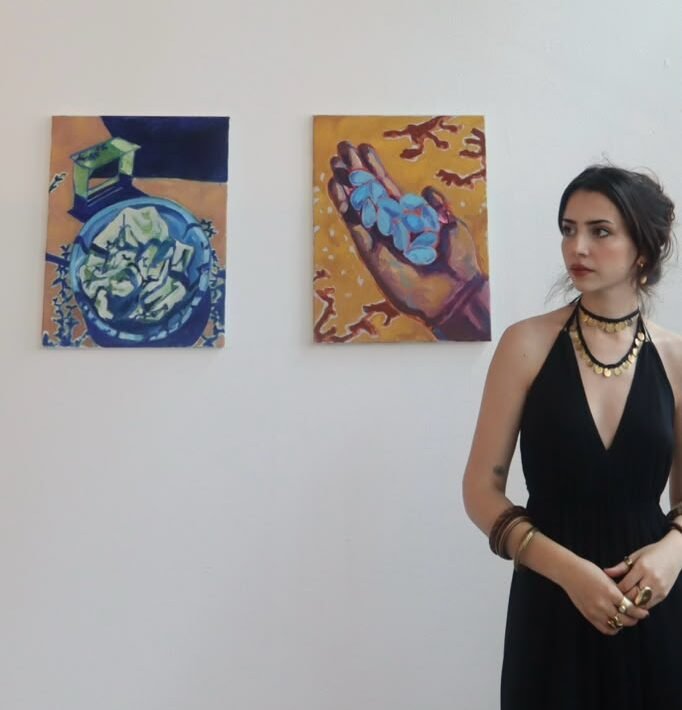
I return in my mind to that fortunate wrong turn on the internet. I followed the wrong algorithm and found the right painter. There is something in this accidental discovery that resembles what her work has given me: a sharp feeling, almost like happiness, which aches even as it heals.
It was not ordinary joy. It came quietly, like a long-lost piece settling back into place. The figures suspended in her paintings carry the pain of being unable to fly, but also the strange peace of being free, however briefly, from gravity. I felt that Malyalızade had found a thin thread of light among the ruins of a divided geography and a fractured identity, and had offered it to anyone willing to look. I thought of Spinoza’s idea that joy can enlarge our power to exist even when the world places limits upon us. Her paintings do not ask us to forget what memory has suffered. They hold that pain with grace and make room for something else. Their hidden happiness lies in the quiet, solitary victory of remembering everything and still being able to say, “I am here.”
Perhaps happiness has always been hiding somewhere in history’s weary passage. Perhaps truth is found less often along the roads we deliberately choose than in the encounters that surprise us when we have lost our way. Perhaps she, too, is somewhere now, in another country, at another hour, painting on another ordinary night. And perhaps, for that reason alone, that night is no longer ordinary.
Just as her paintings are not.
December 2025 · Nicosia


