

My health app starts to crack near day 47 of my menstrual cycle. Since going off hormonal contraception (for good this time!), I’ve started using it to track my periods, and the poor thing is confused. For two weeks it alerted me that my period was due to start. When the window lapsed, it progressed to constant check-ins asking me to log my bleeding. So desperate.
It’s the first time I’ve ever tracked my periods, having skipped the majority throughout my adult life. I was 17 when I first went on the pill, terrified that my inability to control lustful urges would result in an inevitable abortion. After experiencing the wonder of a period-free life, I stayed on various hormonal contraceptives for almost 15 years, incredulous that other vulva owners allowed themselves to go through the painful – and utterly inconvenient – monthly shedding of their uterine walls.
Then, as a 30-something bisexual woman disinterested in cis men, I decided to remove my hormonal IUD last January, heralding in my natural era. It felt fitting to start a new year free of artificial hormones, although it was somewhat optimistic to enact major hormonal upheaval on my body in the middle of London’s winter. Along with mood swings and depressive episodes matched only by the city’s grey skies and guttural winds, I also had to reckon with the return of my greatest adversary: my period.
I first got my period at the age of 12 whilst on holiday. I’d gone to the toilet at a beachfront caravan park, and found blood pooled at the bottom of my swimsuit. I assumed I’d cut myself while in the water. When I realised the blood was coming from my vagina, a revelation hit.
OH MY GOD. I could get PREGNANT.
Never mind that I found the idea of sex horrifying and slightly disgusting. I knew I wasn’t going to try it anytime soon. But I still felt terrified.
Most of my terror derived from the shame instilled by my Catholic parents. My mother had prevented me from doing sex education that year in school. While my classmates learned what periods and erections were, I was sent to be a “helper” for the younger year levels. I’m not someone who ever followed my parents’ word as gospel (pardon the pun). But my spongey childish subconscious absorbed the narrative that if my parents refused to let me learn about the imminent changes occurring in my body, then such changes must be shameful.
Another deeper, subconscious layer of fear erupted from the misconception spread by society that when a girl gets her period, she becomes a woman. I now believe this to be a fallacy created by the patriarchy to enact control over femme bodies. Perpetuated by women and men alike, the idea that a girl as young as 9 can become a woman overnight conflates biological changes in the body with adult notions of gender, dictating that we will henceforth be defined by our ability to reproduce. It flattens our trajectory so womanhood = motherhood.
This idea also conveniently allows the patriarchy to dictate where we are allowed to go; in some cultures, women are not allowed into religious spaces during menstruation, because they are considered ‘unclean’ or sinful. It also relinquishes male responsibility, particularly when it comes to paedophilia and systemic sexual violence. Once your body can physically depict the consequences of any such violence being done unto you, the responsibility becomes yours to carry.
Of course, there’s no way I could have understood any of this then. But even without understanding the why at this young age, I understood the how. Looking down at the pool of blood in my underwear, the fear I couldn’t name was the visceral realisation that my body was no longer free to move through the world without consequences.
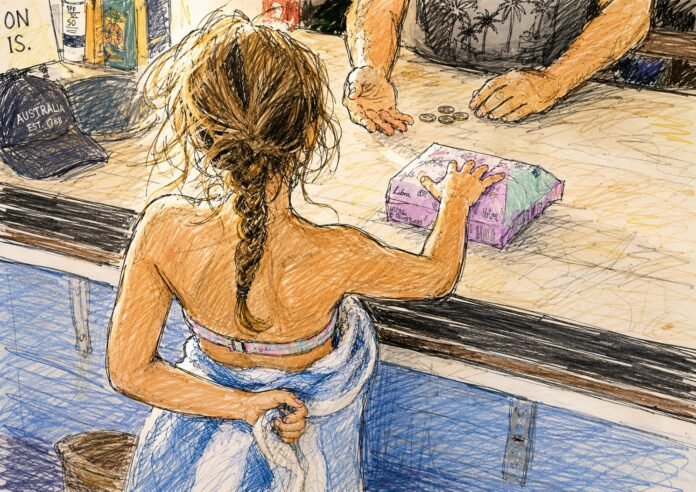
I couldn’t tell my parents, too scared of being chastised for unwittingly exposing myself to what had been banned. Instead, I stole money from my mother’s purse, put on multiple pairs of underwear padded with toilet paper, wore thick long trackpants in the middle of Australian summer, and wrapped a beach towel around my waist for good measure. I really had no idea how much blood could escape my tiny body on the way to the kiosk, and I wasn’t taking any chances.
I waddled up to the counter, trying to prevent the disobedient toilet paper travelling any further up my arse crack than it already had. My heart pounded while I lifted a packet of pads toward the counter. How the shop assistant must have pitied the little girl they could only assume had leaked through multiple layers of clothing by the way she gripped her towel so tightly round her waist, completing the entire transaction one handed.
I laugh about it now, but it was traumatic at the time. For the rest of the holiday, I never strayed beyond knee-deep water at the shore of the beach. I was petrified a shark would catch the scent of my blood and tear me to pieces.
I stole money for over a year. I wore pads and tampons for longer than it takes to get toxic shock syndrome, conscious that I needed my small stash to last as long as I could before I had to steal again. I inevitably bled through these, often at school, but most humiliatingly – for several reasons – at a Backstreet Boys concert.
I was exhausted from the secrecy. One day, I bravely picked up a packet of pads at the supermarket and, palms sweating, tossed it as casually as I could into Mum’s trolley. You need these now? She was unfazed, didn’t even look up. I gritted my teeth, let out a tiny Yep. That was it. The full extent of our period talk. But it was done. I was free.
The well of secrecy around me burst. I suddenly had my period in most P.E lessons. Mum would sign the slip, forgetting I already had my period last week, and the week before. Such a shame to have to sit out of volleyball. The cramps were just that bad.
When my younger sister discovered her own blood-stained underwear two years after me, I marched over to inform mum, intent on sparing her the ordeal I’d gone through.
In our devoutly Catholic house periods were shameful, queerness was suppressed, and teen pregnancy was the devil. As soon as I became sexually active – that is, with someone other than myself – I made a beeline for the pill. It was preferable to running into my parents leafleting outside an abortion clinic.
On contraception for years, I felt free of the constraints that I imagined plagued most of my friends. Whilst they suffered periods on their birthday, or emptied mooncups into drop toilets at festivals, I was free to live my life without my monthly reminder that, to the outside world, my body is a vessel used to transport goods.
I heard friends speak of the spirituality of their cycles. Describing the shedding of toxicity that it heralded, cleansing them monthly and allowing them to start fresh, their bodies a metaphor for the cycles of life and the resilience of women. I always thought it was bullshit.
I never experienced periods as divine. I found them inconvenient at best, excruciating at worst; to me a representation of the cruelty and unfairness heaped upon those with uteruses daily. If endometriosis affected cis men, there’d be a cure. Feminine divinity felt like lying to ourselves to turn something shit into something beautiful, because otherwise it’s just shit.
I always felt free from this, thanks to my hormonal contraception that never passed the trial stage for men because its side effects were considered unethical in modern studies. But my vagina dictated more of my life than my friends’ uteruses did theirs. Between the ages of 18 and 22, at the height of my sexual exploration, I experienced almost monthly recurring urinary tract infections. After numerous tests and ultrasounds, I was told I was “just unlucky”.
By 24, I grew out of UTIs and developed vulvodynia, a syndrome so under-studied and misunderstood that it was given a blanket term that literally means “vulval pain” in Latin. For years, penetrative sex felt like sandpaper scraping against my insides. I couldn’t wear jeans or ride a bike. I struggled to use dilators as small as my pinky finger. I spent hundreds on pelvic floor physiotherapy. My libido completely shut down, which makes sense, considering my nerve endings equated sex with excruciating pain. What had been an outlet for escaping repression had suddenly become the oppressor.
After 65 years on the market, studies are slowly linking hormonal contraception to an array of physical and psychological symptoms. Both my UTIs and vulvodynia have subsided since going off contraception; a stronger correlation here is likely that this is also when I stopped sleeping with men.
Nowadays, I’m reconnecting with my body and its cycles, decades after my peers seemingly connected their own dots. I feel like I’m 12 again, adjusting to new and confusing hormonal changes in my body. I’m just as mystified as my health app. Before my last period, my left breast was in so much pain that I went to the breast clinic, on edge after a recent cancer diagnosis in my family. I felt ignorant when the specialist asked if I’d recently had a period, and I sheepishly admitted I had it right then.
The disconnect sometimes leaves me feeling infantile. I don’t regret my period-free years, but I’m a step behind. My partner understands her changing moods intrinsically compared to the haphazard way I navigate mine. I always assume my period cramps are pain from my Ulcerative Colitis (a form of Inflammatory Bowel Disease that, funnily enough, reared its head post-contraception) until I find blood. Even whilst tracking my cycle, I still forget to buy tampons in time for Aunty Flo. It’s never at the forefront for me.
I’ve spent hours analysing the relationship between my body – particularly my vagina – and my childhood. I grew to hate a natural occurrence in my body that I was taught to see as shameful. I shunned it for years, embracing hypersexuality until my body shed its trauma through the same chasm that should have shed my uterine wall. Pain continues to shift and move through my body, carving out new spots within which to nestle, but I’ve learnt to live with the changes. None exist as absolutes.
Day 48. My period finally comes. This was a long one, even for me. I track it in the app and skew my own data, pushing my next predicted period out by a month. The initial relief immediately dissipates as I realise I have my fucking period for fucks sake. I’m annoyed at the return of my nemesis, despite also being annoyed that it took so long to return. I need to shake this.
I close my eyes. Transport myself to the beachside caravan park. Summer 2004. Dusk sets in, sea salt in the air. The kiosk is closing soon. I walk to the counter, carefully taking little Elise’s pads out of her trembling hand. I pay for them, tuck them into my bag with a wink.
I take her hand, reassuring her, you’ve nothing to be ashamed of. I tell her don’t worry, sharks aren’t into period blood, but I warn her that the pad will inflate the moment you get in the water. We walk, hand in hand, to the toilet.


