

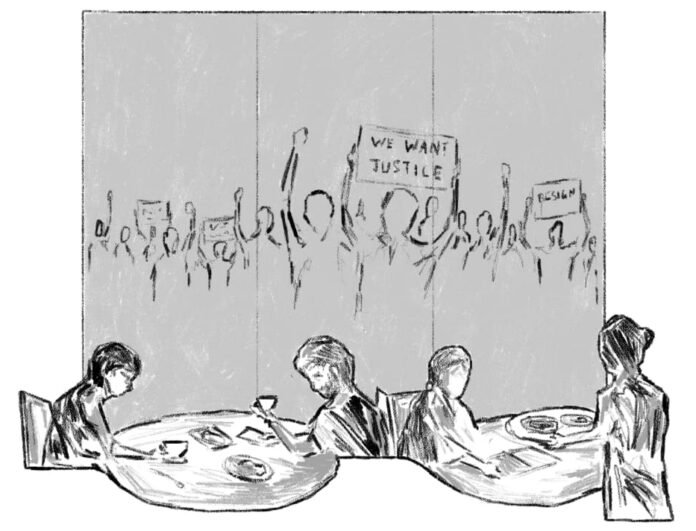
My father had a rule at the dinner table: you could say anything, as long as you could defend it. Not just why I deserved to win another mark on my English Creative Writing test or which visitor was objectively more annoying, but serious topics as well. Whether I was calling myself an atheist just because I too wanted to be like my father or because I had actually ruminated on why gods just don’t do it for me. I was nine the first time I lost an argument badly enough to cry tears of frustration, and my father’s response was not to console me, but to ask what I’d read to prepare for the argument. I learnt to have an opinion, earning it by first weighing the other side of the argument.
Perhaps that’s why it feels strange to have been raised on empathy as homework, only to watch my childhood friends grow up almost allergic to having a position on anything at all. And I don’t mean the kids who never had the dinner table in the first place, I mean the ones who did (marble gilded tables too, at that). Who could tell you, unprompted, why the French Revolution failed its own ideals, but go conspicuously quiet when asked what they think about the government failing to protect its own students through repeated national exam leaks, scant to non-existent accountability and finally, direct violence. Somewhere between Board examinations and adulthood, “I don’t really follow politics” became less a confession than a pathetic garb – one that happens to fit most comfortably on people who were never going to be the ones affected anyway. Being apolitical, I’d started to suspect, is not the absence of a position. It’s in fact, the most expensive position there is, and one you can afford to hold only when you’ve already got your private jet awaiting you above the flood.
Before I get self-righteous about anyone’s silence, it’s important I manage to convey the gravity of just how massively flawed the Indian education system has gradually become. Conducted annually by the National Testing Agency (NTA) (an autonomous government body that standardises and administers high-stakes national entrance examinations), the National Eligibility cum Entrance Test (NEET) serves as the sole gateway to medical education across India. Each year, approximately two million candidates compete for fewer than 150,000 MBBS seats, making it one of the most competitive examinations in the world and for countless Indian families, the single determinant of years of financial sacrifice, and sleepless nights. I paint you a picture of a system where staying ahead in this rat-race is the sole pathway to a promising future. Now imagine the horror that gripped India when the NEET-UG examinations were cancelled on account of a highly organised paper leak scam. Education Minister, Dharmendra Pradhan, confirmed the breach himself at a briefing days later. (That is about as close as a sitting minister in our current economy gets to admitting his own house was robbed while he slept in it). And so, twenty-two lakh odd medical aspirants of India actually had to live everyone’s worst nightmare by having to reattempt a traumatic examination they had already spent sleepless nights over. The nation witnessed atleast twelve students commit suicide over a span of a month, undone by the wreckage of the exams they had sacrificed years for. With 152 paper leaks occurring in the past decade alone, affecting approximately 75 million students, it would do good for the comfortably right-wing fellow countrypeople to finally start blaming the repeatedly failing security more than the supposed burglars.
Public outrage continued to worsen when the Chief Justice of India derided youth activists and the youth as “cockroaches” and “parasites”. In response, a thirty-year-old political strategist based in the USA, Abhijeet Dipke, struck while the iron was hot and founded the satirical youth party, the Cockroach Janta Party (CJP). Despite its manifesto sounding like an AI-generated fever dream, it did what actual political parties in this country have failed to do for years – it gave an entire generation of young people an identity they were willing to fight for. Turns out self-deprecation is a hell of a recruitment strategy. Turns out being regarded as vermin by the highest court in the land is also all it takes to make apathy look uncool again.
CJP’s satirical origins quickly catapulted to a nationwide movement and thousands of students and civilians marched to Jantar Mantar (Delhi’s designated protest site) demanding for the Education Minister, Dharmendra Pradhan’s resignation. It took Sonam Wangchuk, innovator and educationist, going on hunger strike for the protest to receive any mainstream attention. After three weeks, the Delhi Police stormed into Jantar Mantar, forcibly removed him and hospitalised him without consent. A breathing democracy is supposed to acknowledge every citizen’s Right to Assembly and also their right to go on a hunger strike but what followed in Wangchuk’s case proved otherwise for India. While recent negotiations finally did alleviate his concerns and he broke his fast last week, I doubt it would be easy for any of us to forget the aggression the police had no qualms showing while conducting every action that their uniform should have warranted as forbidden and illegal. What should perhaps trouble us more is how unsurprised we were by the police’s conduct in the first place. This is not the first time state force has been deployed against people whose real offence lay only in having different opinions than the others. A democracy survives on the idea that the state’s monopoly on force is held in trust, answerable to the people it’s used against. In December 2019, Delhi Police forcefully entered the Jamia Millia Islamia University during the anti-CAA protests and detained over a hundred students, injuring many. Despite adequate surveillance footage, no repercussive actions were taken and no officers were held accountable. A noticeable pattern can be gauged in which the current ruling force has learned that disproportionate force against dissent carries no real political cost, because the base that elects it has been trained to read every protester as an enemy of the nation rather than a citizen merely exercising a constitutional right.
A rather unique kind of cognitive dissonance seems to have emerged for the students who studied Political Science as a subject in Indian schools. Ask anyone who sat for ICSE boards in the last decade and they’ll recite K.K. Ghai’s textbooks like scripture– the Preamble, the Fundamental Rights, the separation of powers of the government organs (probably with the page numbers rote-learned as well), all of it frantically grooved into memory while studying them for examinations. We could proudly tell you the difference between a Fundamental Right and a Directive Principle. Perplexingly enough, some of us could not tell you why a policeman is not justified in modifying a laathi with iron nails to attack a student his own child’s age who simply wants their voice heard in a desperate attempt to ask for accountability from the government. That’s the part that gets left out when people say “well, some students were pelting stones, so xyz.” Article 19(1) of the Constitution of India that we had once painstakingly memorised, guarantees the Right to Assemble peaceably and without arms. Now unless you compare the singular roses in the protesters’ hands or the Melody chocolates distributed by them to fearsome arms, the students seem to me, only slightly underequipped against the tear gas canisters, laathis and menacing rifles of the cops. And yet here we are, watching visuals of toxic gas fired into what began as a peaceful march, watching children slapped hard enough to draw blood, while primetime anchors conclude that the students must have done something to deserve it. It’s amusing to see how a country that trained an entire generation to recite the Constitution, somehow forgot to check whether the police or governing ministers had done their part of the homework or not.
My parents had one habit they were almost religious about – reading the newspaper every single morning. They would say that a well-informed citizen reads the news daily, just the way other parents say “eat your vegetables” (they did that too, to be fair). I could never quite get behind it. Some combination of childhood laziness and a phone that fed me faster, funnier information won out, and I guiltily realised that I’d failed them on this one. It’s taken a government actively bleeding its own credibility by buying the fourth pillar of democracy for me to realise that this is one habit I’m glad to have failed in. There is a grim, petty comfort in getting to say: “I’m sorry, Baba, but the institution you wanted me to be loyal to, sold itself out before I even got the chance to be loyal to it.” As I sit in my house thousands of miles away from the Delhi epicentre, my only credible source of news seems to be these social media platforms and independent journalists. At least the videos and photos taken by my own friends protesting in different parts of the country, cannot get magically credited to be AI or planted by the CIA, China, Nepal, Pakistan etc (India happens to excel at this: no country is left behind when it comes to playing the blame game) by the ‘apolitical’. Try switching any television on in India, you’ll immediately be ambushed by a certain news channel with a particularly angry, square-faced anchor out-screaming his panelists on how “The Hindus are in danger” irrespective of the issue at hand. While covering the ongoing protests, innumerable anchors like him solemnly recite that the students turned violent first, that the police had no other choice and that force was proportionate (the same, tired sequence aired with the confidence of a channel that knows its owner’s interests and the ruling party’s interests are indistinguishable). Nobody on primetime is questioning the flaw in how “some stones were allegedly thrown by the students” is being treated equivalent to sixteen metro stations on the protest path being shut down overnight in Delhi, or why a government with tear gas and laathis at its disposal needed to also suspend mobile internet in a 1.5-kilometre radius around Jantar Mantar. One starts to wonder if the government is just making sure nobody outside the radius can see what crowd control looks like from the inside.
So I did what my parents would recognise as due diligence, even if they’d wince at the method: I stayed up refreshing X and Instagram at 2 a.m., waiting for some kid who’d managed to walk two streets over and find signal to post a shaky ten-second clip before their battery or their nerve gave out. That, and a few paltry, independent online news platforms are where the actual news is still gasping for its dying breath. Therefore, such a time has arrived where one cannot trust a broadcast licence anymore, but can trust a shaky, grainy, vertical video of someone who’d just watched their friend get dragged by the hair, filming with hands that wouldn’t stop shaking. I’d rather trust the sharp pain in my heart while watching this than the clinical dissection of yet another news coverage on the “evil, ulterior motives” of the students of India.
As I scroll past “democracy died today” on the Instagram stories of people who prior to this protest have never once felt the urge to raise their voices for an injustice in our country, the debater in me cannot help but want to argue against it. Democracy most definitely didn’t die today. It’s been dying a slow, dangerous death in places most of these same people have never cared to even learn the names of. It was dying in Manipur, where Kuki and Meitei communities have spent three years now in a grotesque ethnic conflict- an ugly violence where women have been paraded naked through the streets and gang-raped in broad daylight, where extreme violence and acres of land have burned the communities into hopeless dust. I wonder how a government that proudly boasts of weeding out insurgency with an iron fist has still not managed to procure a practical solution to end the violence. Democracy has been dying in Bundelkhand, where tribal communities protesting the Ken-Betwa river-linking project (a project that will submerge their forests and home) were not even provided with a liveable rehabilitation package, let alone receive the courtesy of the media shining light on their protest for basic living conditions. From the Transgender Act 2026, to the SIR exercised by the Election Commission of India, democracy has died every single time civilians of the State have had to justify their existence to the government under policies that sugar-coat its cruelty. The difference is that none of those fights managed to reach inside the manufactured comfort of India’s upper-middle class the way a national exam scandal did, for it is the first crisis in a decade that could plausibly happen to their kid, in their neighbourhood, derailing their meticulously planned life. I hope some day my apolitical childhood friends, uncles and aunties finally realise that caring about an injustice that upheavals their own lives is but a tiny fraction of the unjust system. In order to uproot it entirely, their newfound empathy needs to extend to the struggles of millions of others even when they naively believe it doesn’t concern them, because it always does.
Now finally, after over a month of relentless protests, Dharmendra Pradhan has announced his resignation. He wrote the country’s youth a letter about not wanting them “trapped in the vicious cycle of confusion”. A section of the public continues to accept the most sanitised version of the transpired events. The minister responsible for a repeatedly compromised examination system offers no admission of failure, instead offering his sympathy for the students’ ‘confusion’ and thereby leaving them all the more disoriented. In the words of the Bollywood actor, Salman Khan, “ It’s done, bro.” Except it isn’t, not really. One minister’s resignation doesn’t rewrite an exam system that leaks with the punctuality of the monsoon, and definitely does not acknowledge the severity of police brutalities, bought silences and the cruelty that has been consistently shown to the children of the nation in the last couple months. Our generation may have taken a while to assimilate itself with enough rage to scare the elders up from their corrupt slumber, but safe to say, no amount of CJP deciding to call the protests off because some of the demands have been answered (conveniently forgetting all the other equally relevant ones that were in the agenda), will make the students bow down to any body until they truly believe that justice has been served and a safer future has been secured.
Why does the apolitical stay silent, even now, even after watching the truth play out in front of them? Political scientist, Partha Chatterjee, in his book, ‘Politics of the Governed’ provided a clearer lens to understand this. He argued that in postcolonial democracies, the institutions of civil society (the courts, the press, the election ballots and even a polite petition here and there) were built by and largely remain most accessible to the propertied, legally literate elite, while the majority negotiate the state through what he calls the political society. The latter are resigned to demanding collective, often extra-legal claim-making in terms of occupation, agitation, the sit-in, the strike. Civil society is therefore not a natural progression of our society, or a neutral blank canvas. More importantly, it is about class position. My apolitical countrymen were not raised to be indifferent to the NEET protests; they were just raised to believe that direct action is something other people do and caring makes them no different from the desperate, the poor and the ones without access or connections. Thus silence is not the absence of their politics but belies the exercise of a civil-society privilege that was mistaking its own comfort for objectivity, and its own distance from the barricade for having no side at all. The apathy that is required to be detached from the extremely real concerns of the youth today, has been systematically generated over years, by a government that benefits from a divided, distracted population. India has been kept busy enough with class resentment and communal suspicion that it stopped looking upward at power and started looking sideways at each other instead. Add a media ecosystem more interested in sanitising outrage than reporting facts, and you get a generation trained to feel that caring is either pointless or exhausting. Therefore, as much as I’d like to mindlessly look down upon my fellow resident apolitical Indians, I am forced to admit that more than it being a personality trait, their apathy has been successfully nurtured as policy outcomes of the ones in power. An economy that can’t create jobs, a healthcare system people can’t afford to get sick under, an education system that leaks its own exam papers, is bound to boil over uncontained to the people directly affected forever. The education reform protests have been a sign of a decade of systemic institutional failure finally reaching the people it hadn’t touched yet. And the apolitical will not be exempt from that, whether or not they’re ready to admit it.
I write as a student of the Indian education system myself, closer in age to the sixteen-year-old with a split lip in Jantar Mantar, Shivaji Park or Jadavpur than to the anchor calling her a rioter, closer to the child sitting atop her mother’s shoulders proudly raising a slogan placard for her own future, than to the minister who still hasn’t resigned. I don’t have a lathi, and I don’t have a press badge that answers to power instead of truth. What I have instead are these words that I bristle in agitation to express, and a stubborn refusal to let “apolitical” be the last word anyone gets to say about people my age. If my father were sitting across from me right now, asking me to defend my stance, I doubt I’d have to struggle for words. As it turns out, I’d rather have this indignation than the practiced silence of those who can afford to stay quiet.

Srijoni Nandi is a Junior Editor at ALMA Magazine. She writes fiction and essays at the intersection of postcolonialism and the performing arts, drawing from her own life as a professional Odissi dancer and literature student.


