

My father appeared in my doorway on the first Monday of the New Year to inform me that my grandfather had died. I responded with the enthusiasm of someone learning their dentist appointment had been rescheduled.
Zayde – Yiddish for grandfather, though in our case it might as well have been Yiddish for “benevolent curmudgeon”- was ninety-four. He’d lived what I assume was a happy-ish life, though happiness and self-awareness were never quite on speaking terms in his case.
The day before he died, my parents moved him to hospice. Naturally, the second his wheels touched the linoleum floor, Zayde demanded to leave, as though hospice were a restaurant with disappointing Yelp reviews. This led to a scene that could only happen in our family – my father, exhausted and soaked from the 405, having to explain to his own father that, no, he couldn’t leave, because this was the place where he had agreed to die.
Zayde riled my father up to the point of performative rage, then flashed a smarmy grin and whispered, “I thought so.” He crawled back into his blankets with the smug satisfaction of a man who had just won a Supreme Court argument. He died the next day.
I’d like to say I’ll miss him, but families are complicated ecosystems. I would have missed him more if he’d been kinder. If he hadn’t pitted his grandchildren against each other like contestants on some sadistic game show.
Zayde self-declared himself the “patriarch” of our family, which he announced with the authority of someone naming a boat after himself. His true gift was the ranking system, an internal leaderboard of all six grandchildren that fluctuated based on metrics only he understood. Matthew, my younger cousin, usually held the top spot until he joined Teach for America, at which point his stock plummeted. I never reached number one. I hit number two a few times, number three more often, and once dropped to number five when my cousin Sammy briefly moved to New York.
Being the only granddaughter meant watching all the boys get Game Boys while I got Barbies. While my Bubbie taught me Scrabble, Zayde taught all my male cousins poker – all of them except my brother Drew, who had “behavioural issues.” Whenever I’d ask Zayde to teach me, he’d refuse and tell me to watch TV. To this day, I don’t know how to be a card shark in Vegas, but I can play a mean game of Uno.
He had two nicknames for me. The first was “Jake,” because my full name required too much effort. The second was “Princess,” delivered not with affection but with disdain – the equivalent of “Karen.” He only began using my actual name, Jacqueline, after I moved to New York, as though living in a sufficiently expensive zip code had finally earned me the right to my own identity.
My lowest point in the rankings – The Great Devaluation of 2020 – occurred over Labor Day weekend during the pandemic.
I’d been laid off from PBS in July and was floating through unemployment when my grandparents asked me to visit them in San Diego. My parents suggested two days. “That should be enough,” my mother said, with the certainty of someone who knew. Being naive, I convinced them to let me stay four days instead.
Big mistake.
The first day, they were grandmotherly and grandfatherly. The remaining three days, I became their indentured servant. My Bubbie needed an Etsy account for her handmade Victorian button bracelets. This led to photographing each bracelet, writing product descriptions, troubleshooting why no one was buying them, and becoming her de facto IT person.
Then Zayde noticed my efforts and wanted in on the action – for himself.
He claimed to own an extremely rare Michael Jordan hologram card. “Only three people in the world have this card, Jake,” he said. “Me, Nike, and Michael Jordan himself.”
The card was nothing to write home about – thick, black and white, with a holographic image of Jordan dunking. A small scratch marred one corner.
I created an eBay account and struggled to photograph the holographic effect.
“These are terrible,” Zayde confirmed. “Do it again.”
After migrating to his bathroom for better lighting, I finally got passable photos.
“How much are you asking?”
“A thousand dollars!”
“That’s not gonna happen. There’s a scratch on it.”
“It’s priceless, Jake.”
“Clearly not, since we’re selling it on eBay.”
This was classic Zayde – overestimating value. As “patriarch,” he believed he could determine worth at will. We were all just stocks in his portfolio, rising and falling according to metrics only he understood.
Within hours, offers flooded in. A serious collector emailed offering five hundred dollars, explaining he owned the fifth-largest Michael Jordan card collection. He’d recognized it as a Nike promotional item from 1985. I looked him up. He was legit.
“But he wants only five hundred?” Zayde fumed.
I negotiated. “I got him to agree to six hundred!”
“Just six hundred?”
“It’s a hundred more than he originally offered.”
“This guy’s a hustler. Write him back. Tell him no deal. The card is worth eight hundred.”
“But you said – ”
“Do what I say, Jake!”
After several exchanges, the buyer walked away. It was ten o’clock at night. I’d been at Zayde’s desk since five p.m., building an eBay page for a stupid card. Six hundred dollars seemed pretty good to me, considering I was receiving biweekly unemployment checks just to pay rent for my empty Boston apartment.
But for Zayde, it wasn’t enough. Nothing ever was.
“What did you do? What did you say to him?” He demanded.
“Nothing. I did exactly what you told me.”
“You’re the writer! Your father’s an attorney! Where’s the creativity? Where are your negotiating skills?”
“I didn’t go to law school, Zayde. I was an English major.”
“English major,” he mumbled. “No wonder you’re such a failure. Useless. You couldn’t even keep your job in Boston.”
That didn’t make me angry. This did:
“If your cousin Matthew were here, he would have done a better job than you.”
The next day (zero apology, naturally) Zayde asked me to edit his Storyworth manuscript. I sat at his computer, reading sad stories about his childhood. One was about a bike his father, Grandpa Al, had saved up to buy him. How Zayde had hated that bike. How ungrateful he’d been to poor Grandpa Al, who barely spoke English, had little money, and was just trying to achieve the American Dream after passing through Ellis Island from Russia.
The gist: Zayde had been an ungrateful brat who thought the world owed him everything. He was thankless that he’d married a woman who’d given him three children, ungracious for the life Grandpa Al had wanted for him, and unappreciative that his own children had become more successful than him.
On my last day, Zayde wanted to watch a movie. Having mentally checked out, I deferred to him.
“Well, why don’t we watch your favorite movie, Zayde.” Then I realized. “Wait, what is your favorite movie?”
I assumed he’d say something classic. Citizen Kane. Casablanca. When I was younger, we’d watched My Fair Lady together.
Instead, the old man said, “The Bridges of Madison County.”
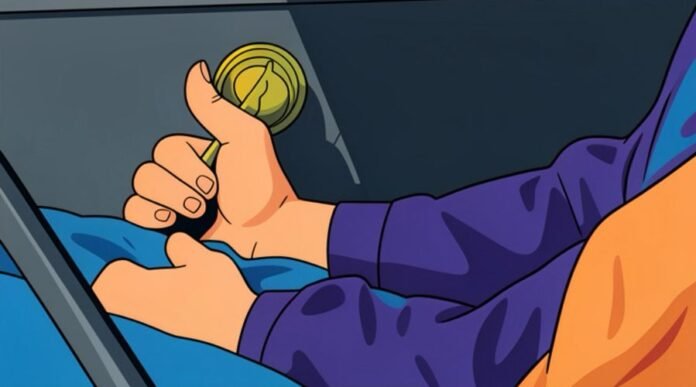
I’d never heard of it. But here’s all you need to know: Meryl Streep plays a housewife in rural Iowa. Clint Eastwood plays a photographer passing through. They fall in love. He tries to convince her to run away. She decides to stay with her husband and children. There’s a pivotal scene where Clint’s car pulls up next to the vehicle Meryl and her husband are in. She reaches for the door handle, about to abandon everything. At the last moment, she stays. He drives away. They never see each other again.
That scene – Meryl’s fingers on the door handle – is when I turned to see Zayde crying.
“It’s just so sad,” he wept. “She wants so badly to be with him. And he was right there!”
The next day, I returned to Los Angeles and told my parents about my four-day ordeal. Also about Zayde’s favorite movie being a Meryl Streep film.
“Of course it is,” my father said, rolling his eyes.
I wondered why that scene affected Zayde so deeply.
Then I realized: Zayde didn’t see himself as the patriarch. He saw himself as Meryl. The victim of his own life, a man trapped in isolation while the world turned without him. Once full of promise and potential, then suddenly stagnant with his wife and kids while his “Clint Eastwood” (the rest of his life) passed him by. He’d succeeded in what Grandpa Al wanted for him. He had achieved the dream, but he hated the dreamer.
When he died, he was still clutching the door handle of a life he wished had gone differently.
It’s a terrifying thing to reach ninety-four and realize you’ve spent your life as your own gatekeeper. Zayde died thinking he was the one left behind at the crossroads, never realizing he was the one who had built the fence.
My only hope is that when my turn comes, many, many years from now, I am not blinded to the difference between a sacrifice and a self-inflicted wound. That I look at the people around me and see a family, not a cold, ranking system. And that I realize the door was always open, held by people who loved me effortlessly and beyond calculation – people who never searched for perfection the way Zayde appraised a rare collectible to estimate its value.
I am not a Michael Jordan hologram card to be tilted under the fluorescent lights to hunt for hairline scratches that proved I wasn’t enough.
Real families don’t negotiate your worth at auction. They see the whole person at once – the shine and the scrapes – to understand that some things don’t need to be perfect, or even profitable, to be priceless.

Jacqueline Abelson is a writer based in New York City. She is originally from Pasadena, California and graduated from Mount Holyoke College. The Door Handle is her first essay in ALMA Magazine.


