

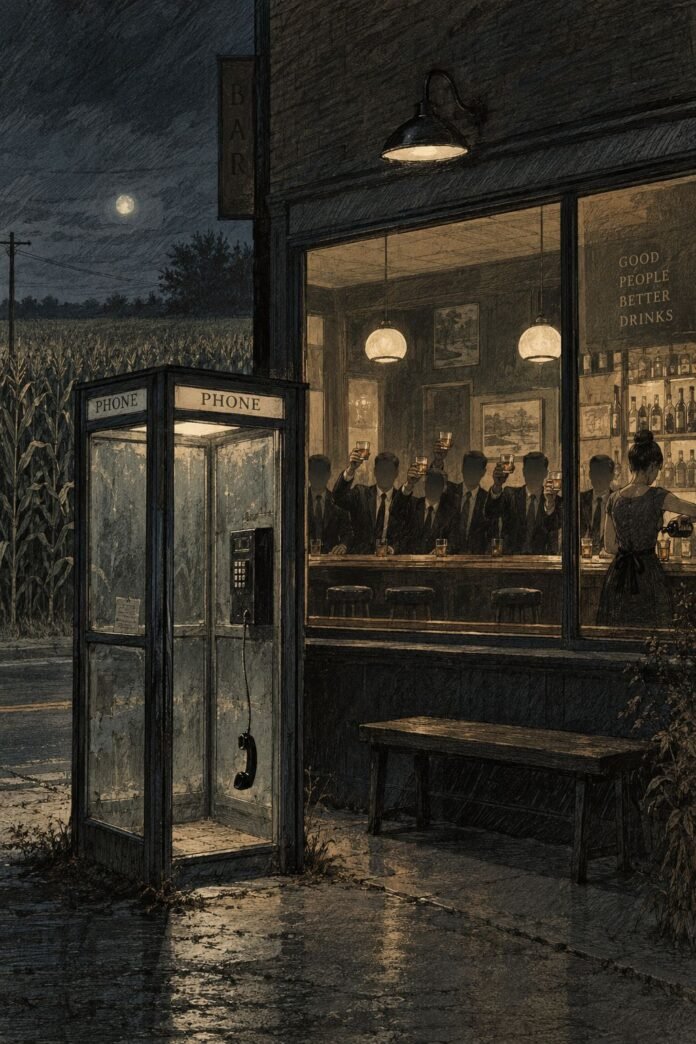
Roger, because he gets everywhere first, was already in The Dumb Horse Pub, staring at his good looks in the mirror behind the bottle display, when I entered and saddled the stool beside him. The Dumb Horse was no bigger than the middle-class living rooms we prowled. On the walls were sad, downcast sconces to match the toothless locals. I’m saying toothless in the literal sense here. From my experience as a salesman for Ellis Vacuums, the people of Central Illinois, though embarrassments to dental hygiene, carried quite a bite.
“Whiskey neat,” I told the bartender and dropped my pinch hat on the counter. “I don’t even want to talk about today.”
“OK.” Roger’s brown drink, which rested on a little black napkin, I saw was chiefly ice water. He took the world’s littlest sip. “Don’t.”
“I got into three homes,” I started.
A second later, the whiskey came. Three seconds after that, it was in my gut. I motioned for another and said:
“Each time the ladies went through the whole demonstration. I show them the woodchips, I show them the confetti. The moment I bring up price—the moment—everyone says the same thing.” In a mocking voice: “‘I don’t feel comfortable making that kind of decision without my husband present.’”
“Did you tell them about the ten-year warranty?”
“Yes.”
“What about the first-timers discount?”
“Always.”
“And the friends and family discount?”
“Of course.”
“Well, there’s your problem.” Roger smirked. “You’re overselling. Never let them see you sweat.”
I could’ve clobbered him for that, the punk, who, by the way, had not strayed from his reflection this entire conversation. In the mirror his head reached over the bottles, while my sad mug, stooped a little lower, was caught by them. Not that I was eager for a clear view. Over the last couple years I had wrinkled into a melted candle.
“Repetition, repetition, repetition,” I said. “That’s the cancer of the sales game. It’s always repetition. I’m sick of the same stuff.”
“I never get tired of the word ‘Yes.’ Heard it six times today.”
“You lie,” I said, though I knew it was true.
“I don’t.”
“I know.”
Another whiskey came and disappeared immediately. I sleeved my lips.
“My luck is gonna change, though, I can feel it. We’ve got Bandville tomorrow. That’s good territory. Ten bucks says I outsell you.”
“I’m sure you will,” he said dispassionately. “Cuz I’m not going. Boss called me back to the city. Wants to see me tomorrow. Says he wants to talk about ‘my future’?”
“Your future? Do you think it’s the Chicago promotion?”
“It’s about time. I’ve been on the road three years already. All this travel does something to a man, sucks him dry.”
Now I really could have clobbered him. I’d been on the road for fifteen years! The commission mission is a ridiculous way to raise a family, something a young guy like Roger couldn’t understand, and on more than one occasion, I thought the boss hinted that the Chicago office promotion was mine. “You’ll be coming home soon enough,” he told me in confidence after our yearly all-men meeting. Not that home was a panacea, what with the wife’s complaints and all. But a father should watch his kids grow up, I figured, and a regular salary might make her happy.
“Well, congratulations,” I said, channeling every ounce of good manners Mother instilled. “I’m proud of you.”
“Thanks.” He darted a glance toward me for a second, probably less.
“It’ll be a shame to hit Bandville without you, friend. I hoped we could visit The Silver Boot together.”
He sipped. “They closed down a year ago.”
“What? No. I would’ve heard.”
“Bob Anderson told me. There was some kind of shootout. Cops shut it down. A few people died, I think.”
The Silver Boot, everyone agreed, was the finest watering hole in the Central Illinois Territory, the sort of bar one dreams about as a child. Three pool tables meant there was never much of a wait, even when it got busy, which it often did. Near the bathrooms was a slot machine that, rumor had it and experience confirmed, favored drunk patrons. And, of course, Sandy, a barmaid, a beaut. Memories of her mammaries often returned during my more, ahem, intimate moments, both alone and with the missus. Female bartenders were rare back then, but her dad owned the place, and everyone loved her, so the normal rules didn’t mean much.
Another thing. Bandville County was moist, meaning no booze sold after six p.m. That rule, however, also didn’t affect The Silver Boot, which stayed open until one a.m. How they skirted county law, I don’t know. Some greased hand must’ve kept their doors open, and, I admit, the place’s illegality was part of the appeal.
So not only was The Silver Boot the best bar in Central Illinois; it was the only bar in Bandville open after work, ergo, my main question that evening with Roger was: without The Silver Boot, how would I get a drink tomorrow night? When I confided this concern, like a sap, to my colleague, he replied:
“You can always buy booze during the day and drink in your motel at night, if it matters that much to you.”
“I could.”
Though I knew, and he knew, that any booze I purchased on the clock would lose a few fingers before the whistle rang. I couldn’t afford another incident, not after last time.
Smugly, Roger paid for both our drinks. With an exaggerated sigh, he dismounted the stool. Patting my back:
“Don’t worry, old timer. They’ll call your number someday. Now I better go. Big day tomorrow.”
Whistling a tune, he left. I swear I could have clobbered him, the punk.
. . .
Despite the two whiskeys I drank with Roger and the two more I drank after he left, that night in the motel, I couldn’t sleep. Why couldn’t I sleep? Because tomorrow night, I feared, without booze, I would not sleep. The threat of no sleep is enough to keep any man awake. So I sweated under the pink comforter and, around midnight, fed up, threw it off and put on a trench coat and pants.
All this worry over the word of Bob Anderson: a drunk, which hurt his credibility, and a salesman, which hurt it more. Nobody in Ellis Vacuums was a bigger fan of The Silver Boot than me. If it closed, I would’ve known. Some philosopher said something about not suffering before it was necessary, right? Good advice. A quick phone call, I figured, would reveal the truth. Then I could suffer or not suffer properly.
Across the street from the motel parking lot, before a sea of head-high corn, was a lonely lighthouse phone booth. Even in summer, Central Illinois nights were cool like mountain air. I crossed the street, arms tight to chest for warmth, and entered the booth, where a water-warped five-year-old Yellow Pages was attached to the wall by a thin chain. Inside the paper brick, under Bars, was The Silver Boot, 235 German St., Bandville, IL. Fingers shaking, I dispensed a nickel and punched the number.
Two rings, then:
“Hello, The Silver Boot,” a woman said over music, her voice made crunchy traveling through telephone. “Sandy speaking.”
“Oh, thank God.” I leaned against the glass, relieved and aroused, I admit, imagining on the other end plump arms holding the phone to red lips. “I was calling to see if you guys were still open. Someone told me The Silver Boot was outta business. They said cops closed you down. Some kind of shootout.”
“Don’t believe everything you hear,” the voice said. “We’re very much alive.”
“Beautiful,” I sighed. “I’ll be there—”
“Wait a sweet pie minute,” said Sandy, excited. “Is this Declan Gibbons, the best vacuum salesman in Illinois?”
I was gobsmacked. Silent. In dead air, the earpiece revealed background crackly bar sounds. The snap of a pool break, glasses clinking. A slot machine spun. Lock, lock, lock, then someone yelled: “Winner!”
“Ye-s-s-s,” I stammered. “This is Declan. I’m amazed you recognize my voice. I haven’t been to The Silver Boot in, jeez, in—”
“In three years,” she interrupted. “It’s so nice to hear from you, babe. We miss you here.”
“Really?”
“Oh, yeah. We talk about you all the time.”
“That’s wonderful!”
“To what do I owe the pleasure?” she asked.
Blushing: “Oh, well, I’m going to be in town tomorrow. Like I said, someone told me you were closed, but I wasn’t sure. Thought I’d call to find out.”
“So you’re coming tomorrow, here?”
“Yup.”
“Yay,” she trilled. “Can’t wait. I’m frothing, babe. See you soon.”
Then she hung up. A bit abrupt, I thought, but I didn’t give it much mind. Tomorrow my drink was secured, and with eager company. I ripped The Silver Boot’s page from the book, for what reason I wasn’t sure—somehow I figured it would be useful—then returned to my motel room and slept peacefully.
. . .
Here’s a joke. What do you call a vacuum salesman who works one hundred percent commission? A real sucker.
Doors to the face is most of the job. The next day, no surprise, I ate wood twenty times back-to-back. Whatever, I can shrug that off.
But say you’re in the house and the lady gets talking about her vacuum needs; when you’re close, that’s when the no-deals punch the wind out. Four Bandville housewives let me in. Three gave me the ol’ I-can’t-without-my-husband. One was ready, though, primed. She sat through the woodchip demonstration, the confetti demonstration. The price, she said, was reasonable. But then, during the final sand demonstration, which was probably overkill on my part, then her Schnauzer volunteered his loud, yipping review.
“Sorry, sir.” She smiled apologetically, teeth gray and crooked. “The master of the house has spoken. It won’t work for me.”
“He’s just responding to Ellis’s superior sucking capabilities,” I rejoined. “They get used to it.”
“I’m sorry.”
“It has a ten-year warranty, you know. If the little guy keeps barking, you could return it.”
“No, I don’t think I’m buying.”
“We have a first-timer’s discount.”
“It’s a no for me.”
“I can add a friends and family discount.”
“Please leave my home.”
God, I hate dogs.
I’m a dog myself, though, really, a neutered pet built for the chase. Every morning I chase commission, but at some point, usually a little after lunch, if you haven’t made a sale yet, a dog can sense it’s not their day. When sales are dryer than Grandma’s turkey and my Lincoln coughs something awful, then I’m chasing the day’s end, and the alcohol that end shall surely bring. Today, humid and disappointed in Bandville, I thought often about Sandy and everything else waiting, frothing, for me in the best bar in Central Illinois.
Eight p.m., sundown, I dropped my baggage at the night’s motel, just a few miles from downtown, and left for The Silver Boot. My Lincoln sang nervously at each brake, but I didn’t concern myself with that. Tonight would be a good night. Tonight, I thought eagerly, driving with the windows down, sniffing engine fumes, tonight, if the opportunity came, I would cheat on my wife.
Nothing would come from this decision, I reasoned. Sandy was just a flirt, and I doubted my luck with anyone else. But sometimes you just gotta give yourself permission to dream. It felt good entering the evening as a bachelor. At a stop light, I removed my ring and dropped it in the glove compartment.
Downtown Bandville, which lived primarily on a main street called Main Street, was an old-timey affair. Boardwalks connected the buildings, most of which bore the name Richard T. Longing, a man who, I guess, built the town. Brown clapboards and two doghouse dormers made Richard T. Longing Grocers. The Richard T. Longing Post Office was bright blue with bars on the windows and an American flag flowing forlornly out front. All was quiet, deserted, except the buzz of streetlamps. That was the first sign of trouble: the quiet. Drawing to the end of Main Street, nearing German Street, I anticipated The Silver Boot’s laughter and music, promised just around the corner. But there were no good-time noises, I noticed. Then I turned and saw why. There was no Silver Boot.
Well, that’s not completely true. The body of the bar remained, decomposing. Over its wide wall-sized windows was a faded red sign with silver lettering, The Silver Boot, missing the second T. Surrounding the letters were incandescent bulbs, all turned off. Inside the windows: a black abyss. No one was home. And on the door (X marks the spot) was criss-cross police tape. It was exactly the scene of a shutdown, and I cursed under my breath, parking beside a phone booth across the street. I took out the Yellow Page and compared the address. Yup, 235 German Street. This was it.
A mixup, I thought; obviously a miscommunication, but one with dire consequences. Panic made my movements sharp, angry. Sharply and angrily I left the car for the phone booth, where, glancing back at the abandoned bar, I surrendered a nickel and punched the number.
Two rings into my right ear, then:
“Hello, this is The Silver Boot,” she spoke crackly over the music and merry sounds I expected at the turn. “Sandy speaking.”
“Sandy,” I began. “The weirdest—”
“Declan, is that you?” she exclaimed. “We’ve been waiting all day! Where are you? Come in, come in.”
“That’s the thing. I’m a little confused about your location. Is the address still 235 German Street?”
“Ja,” she said cheekily. “That’s us. Where are you, babe?”
“I’m in a phone booth across from the German Street address, and—”
“You are? Ohmygod, you are! I see you. Don’t you see us?”
Wordlessly I stared at The Silver Boot’s windows, into the black. Through the earpiece came familiar sounds. The snap of a pool break, glasses clinking. Spin. Lock, lock, lock. “Winner!” Inside, though, there was no Sandy. There wasn’t anything.
“No, I don’t see you,” I mumbled. “It’s dark.”
“People always say that. We’re open, come in.”
“There’s police tape out front.”
“Don’t worry about that, honey,” she giggled. “Come in. Please. We’ve been waiting a long time to see you.”
I was stammering. “Um, I—”
“Wait, wait, someone wants to talk to you.”
The muffled shuffle of a phone handoff, then came a familiar voice.
“Hey there, friend.”
“Roger?”
“The one and only.”
He sounded chipper than I heard him last, chipper than I had ever heard him. This must be his salesman voice, I decided, and wondered why he would apply it on me. And why wasn’t he in Chicago?
“What are you doing in . . .” I stared into the windows, which weren’t black like a shade but black as in the scientific sense, an absence of light, a flat nothingness. “. . . in there?”
“That’s right,” jolly Roger said. “You probably expected me in Chicago. Funny story about that.”
In the morning, Roger explained, he spoke to the boss over the phone to confirm their appointment. But the big man (“. . . you know how quickly he changes his mind . . .”) decided he no longer wanted Roger for the promotion.
“It’s too bad, but I’m young. They’ll call my number someday.”
Instead the boss wanted someone with “more experience,” Roger said, and I thought: Damn right. So rather than Chicago, Roger was redirected to The Silver Boot, where everyone was there to meet me.
“Who’s everyone?”
“Ope, I guess I ruined the surprise,” Roger giggled. “We have everyone in the Central Illinois Territory here. Greg, Bob, Dave, Christopher, Adrian, and, get this, the boss! Come in. The boss wants to talk about your future.”
“What?”
Excitement was a little electric shock to the gut, and with it came hope. People hallucinate their reality, so says the philosopher. Could it be? Was it possible The Silver Boot was alive like the phone suggested, and some trick of light and brain made it invisible to my senses? Roger’s comments made me more livened (and impressionable) than skeptical, which, you should know, is exactly the state salesmen want to generate. We’re all suckers, truth be told, everyone, no one is immune to every sale.
“Don’t you see us?”
“I really don’t.”
“Look closer, friend, look closer.”
Automatically I squinted at the black windows.
“Are you looking closely?”
A miracle. Like a photograph in dark room chemicals, my God, The Silver Boot developed into reality. There, I saw it in the window, was the wooden bar, first as a shadow, imbued quickly with lighter details. Then appeared black-and-white men seated on its stools. Color bled into the men, who all wore pinch hats and flashy suits. Christ, they were my colleagues! Greg, Bob, Dave, Christopher, Adrian, and, at the end of the bar closest to the pool tables, the boss. They all turned toward the window, frozen with the same smiley expression, and lifted their glasses in my direction. On the other side of the bar, pouring beers from the tap, was Sandy, turned away from me so all I saw was her curvy backside and flowing waterfall of red hair.
I was silent, wavy-headed by the bar’s appearance and mesmerized by the amber light that seeped through its wide windows. The police tape was gone, the incandescent bulbs alight again, the T returned, and through the phone I heard the crackly snap of pool, glasses clink, and the spin of a slot machine. Lock, lock, lock. “Winner!”
“I bet you see us now, don’t you?” Roger said. “Why don’t you come in, Declan? We want you here. Really, we need you. Come in.”
“OK,” I said, dazed, and hung up the phone.
Most people in this position would have flashing red lights in their heads. The important thing to understand, however, about my situation was I lacked the wherewithal to conjure a survival instinct. Something about Roger’s voice, or the bar’s sudden appearance, had an inexorable magnetic quality. I approached the bar, slowly, in a hypnotic state, as if pulled by river rapids, unable to understand what was going on or why decisions seemed made for me. Otherwise I would’ve clocked this as strange, and what came next stranger still.
Even as I drew nearer, by this point halfway across the street, the bar’s noises, rather than emanate from the bar itself, arrived only in my right ear, where the phone was moments ago, and registered aurally with the same crackly phone effect. Faint music. The snap of pool, clinking glasses, slots spinning. “Winner!” Roger’s voice, too, spoke into my ear, goading me forward.
“I told the boss about the Lincoln, Declan,” it said hurriedly, as if I were going to hang up, which, of course, I could not. “He says he’ll replace it. Now how about that? You can’t beat that, can you?”
Now reaching the sidewalk, zombified.
“Sandy wants you, she told me. She wants to make love to you. Also, guess what. Drinks are on the house.”
I arrived at a door of wavy glass and amber glow. My fingers hovered toward the brass doorknob.
“I bet you’d like to hit me, wouldn’t you? Go on, I deserve it. Come in and I’ll let you give me a good clobbering. Comeon!”
And just before I grasped the knob, a thought broke through my hollow head and resonated like a piano key: “Roger really is selling hard, isn’t he? It’s not like him to sweat this much. Jeez, is that what I sound like?”
Then, as if someone flipped the switch, the bar’s power disappeared. No more amber glow. The voice in my ear plugged, and I stood before criss-cross police tape, wobbling, dazed. I stepped backward, and I’m lucky guy for gaining distance, because who knows what would’ve happened if I remained closer to the door.
A moment later the door swung inward and revealed a black emptiness like a big mouth. And a mouth really is an appropriate descriptor because it, the doorway, generated a sucking unlike anything I encountered in my fifteen years hawking suck technology. Tornado-speed winds sank into the black, devouring the police tape, then my hat, and bits of litter nearby. All I can say is thank God for Navy training. The second my soles slipped toward the doorway, overtaken by wind, I turned around and hit the deck, gripping the curb as the sucking grew stronger.
“Come in, Declan, we want you here!” cried the abyss, no longer speaking with Sandy’s voice or Roger’s, but instead a chorus of voices, an army of voices, screeched in unison from some unknown place within. “You belong with us, Delcan! We love you!”
The sucking increased and lifted my legs several feet off the ground. I clung to the curb like how Buster Keaton clung to the back of moving trains. Legs flailing. Nobody would’ve given me a strength award back then. I doubt I could’ve done two push-ups earlier that morning, but desperation, as every salesman knows, has a motivating effect.
“Give up, Declan, you belong here!”
Channeling every ounce of strength, I crunched my knees to my chest and tried lowering my soles to the concrete. But they slipped and my feet flew skyward again. On the second attempt, though, shoes found purchase with the ground and dug in. Now I was in a sort of bear crawl position, ass upward, sweat wetting my thin hair. There would be only one chance, I knew. It was risky.
On three, I told myself, heart like pistons.
One, two . . .
I heaved forward, pushing my body against the wind and over the curb. Now I teetered with my face and chest in the street, and my legs dangling upward. I army-crawled forward, still battling an impossible pull behind, and by some miracle brought my feet over the curb and pushed a little more. When I was fully in the street, flat on the ground, that very moment, lying below the wind’s reach, it stopped.
For a minute, maybe two, I lay there finding my breath. When I felt capable, I lifted myself up, dusted my pants, and stared at the bar, now closed, black again, and missing its police tape.
“Jesus Christ,” I laughed and looked up at the stars, which, I realized for the first time, were far more visible than in Chicago.
I turned around, refused to look at it again, and returned to the Lincoln, where, first thing, I rescrewed my wedding ring into place. For more than one reason there was no hope for sleep that night. So, upon entering my motel room, I brought the ol’ typewriter to the desk, where I stayed until morning drafting and redrafting my resignation letter.


