

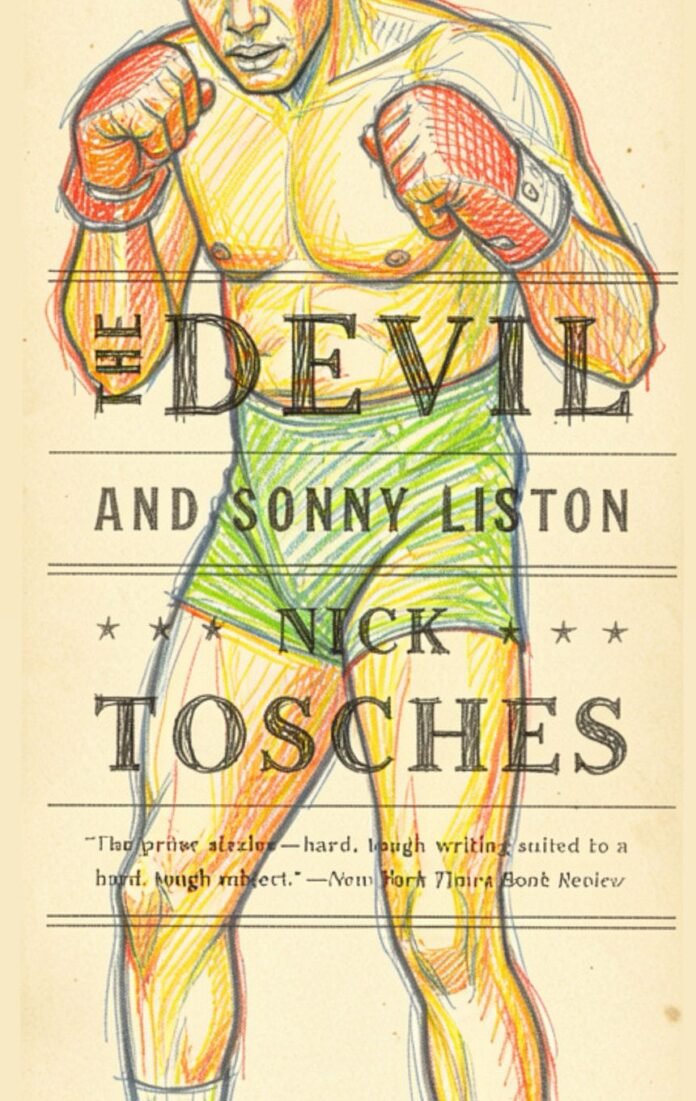
“Interpretation is the revenge of the intellect upon art.”
—Susan Sontag, Against Interpretation.
“The way paranoia has of understanding anything is by imitating and embodying it. (…) What does knowledge do—the pursuit of it, the having and exposing of it (…)”
—Eve Kosofsky Sedgwick, Paranoid Reading and Reparative Reading.
“It takes two to Tango.”
—Sonny Liston
****
Nick Tosches opens The Devil and Sonny Liston with a dedication that already unsettles the ground on which the reader expects to stand: “To a bench in the old neighbourhood, and to a star that over it shone in the heat of the summer night.” Quite an unusual gesture, as far as dedications go. Unless one recalls D. H. Lawrence’s “To Else”, which opens a state of aporia, Else being either a person bearing that name, or simply “someone else”, potentially “everyone.”
And indeed, it could be anyone there, musingly lingering as if about to sit on the bench. One could imagine sitting there. And in a way, I did. As if pausing mid-step, I found myself drawn into the book the way one sits on a bench without quite knowing why. The night was still young. The conversation with Nick Tosches had already begun.
Nick Tosches does not dedicate his book to a person, nor does he evoke a memory. Instead, he spectrally sketches a place, a scene, both pregnant with a presence defined by absence. Even the bench is awaiting, as much as the light is suspended, almost flickering. The figure seems to have left only moments ago; one might still imagine the warmth of the blood it has left hovering behind. The dedication redirects attention toward what cannot be fully located, only sensed.
In doing so, it establishes, from the outset, an unstable economy of visibility: something is offered to the reader, but not enough to secure it. This opening gesture already sketches what might be called an architecture of absence, a structure in which what matters most is not what is shown, but what is withheld, deferred, or rendered inaccessible.
To read such a gesture requires a form of attention that does not seek to stabilise meaning too quickly, to resolve absence into symbol or anecdote. It calls instead for what might be termed an ethics of attention: a mode of reading attuned not only to what the text presents, but to how it distributes light, visibility, credibility, and narrative weight. What is made legible? What remains in shadow? —and at whose expense?
From this perspective, reading becomes necessarily disobedient. It resists the impulse to follow the text where it leads without question, and instead lingers on its displacements, its evasions, and its structuring omissions. It asks not only what the text says, but what it makes possible to say, and ultimately what it prevents from being said. The dedication does not simply open the book atmospherically; it models the very operations through which the narrative will proceed.
That said, this way of reading did not begin with the dedication. It emerged much later, almost as a resistance. At some point, a discrepancy became difficult to ignore. For a book so invested in reconstructing the life, myth, and afterlife of Sonny Liston, one figure remained conspicuously absent: Joe Glaser, his manager, a man deeply embedded in the economic and promotional machinery that shaped Liston’s career. The recognition of this absence did not immediately produce a theory. It produced something closer to a hesitation—a sense that what was being offered could not be fully accounted for by what was shown.
I had encountered something like this before, in a different setting. Walking through a natural history museum with my then 6-year-old son, he paused in front of a display and remarked, with quiet insistence: “they don’t have the pachycephalosaurus!” The skeletons were there, carefully assembled, narratively ordered, but what he noticed was not what was present—it was what was missing. That remark, in its apparent simplicity, names a problem of attention. Not everything absent is equally visible; not every omission is equally legible. Some absences are organised, structured, even necessary to the coherence of what is being shown. It is from this recognition, not from the dedication alone, that the need for a different mode of reading emerged.
N.B. Unless otherwise indicated, all page references refer to Ed. Little, Brown and Company, first edition (2000)
I. The Shock of Recognition: Aristotle, Slavery, and the Bond of Trust
One of the most intellectually electrifying moments in The Devil and Sonny Liston occurs very early on, when Nick Tosches turns to Aristotle—not merely as a monument of Western thought, but as a technician of domination:
“He who is by nature not his own but another man’s, is by nature a slave,” said Aristotle. While acknowledging that “others affirm that the rule of a master over slaves is contrary to nature,” Aristotle concluded that “some men are by nature free, and others slaves, and that for these latter slavery is both expedient and right.”
p.31
The quotations are neither softened nor neutralized by historical distance. Tosches lets Aristotle speak plainly: that some men are “by nature free,” others “by nature slaves,” and that for the latter, slavery is not merely useful, but just. He lingers on the syntax itself, on the ease with which “just” follows “useful”. The gesture, far from being decorative, exposes a structure of justification in which inequality appears as necessity. Aristotle is not treated as an unfortunate man of his time, but as an architect of legibility—one who renders domination thinkable, and therefore acceptable. Besides, the reminder that Aristotle owned slaves, took an enslaved woman as his wife, and fathered a child within that system is not anecdotal. It binds philosophy to practice, even to complicity. Thought does not stand apart from power; it participates in its articulation.
Aristotle owned fourteen slaves, and kept a slave woman, Herpyllis, as wife, by whom he had a child, Nicomachus. (…) Of what Aristotle called the “three corresponding perversions” — tyranny, oligarchy, and democracy,” he judged that “democracy” is the most tolerable of the three.” But democracy precluded slavery no more than did the other perversions of government.
p.31
What follows is equally disquieting. Tosches insists that slavery is not a racial aberration but a recurring human practice. Greeks enslaved Greeks. Africans enslaved Africans. Slavery predates Europe, predates Christianity, predates modern racism. It is not imported from elsewhere; it reappears wherever conditions allow. The effect is not to excuse, but to displace the grounds of moral comfort. No position of innocence remains intact.
At this point, a form of trust is established. The text appears committed to a rigorous exposure of power—unsentimental, structurally attentive, resistant to consolation. The reader is invited into a regime of attention in which nothing is naturalized, and no hierarchy escapes scrutiny.
“Enough,” he (Aristotle) declared, ending his treatise on slavery in the first book of the Politics, “enough of the distinction between master and slave” (…).
p.31
It is in light of this early rigor that a later passage becomes difficult to ignore. Much later in the narrative, almost buried beneath the reader’s accumulated fatigue, as if to escape memory itself, Tosches suggests that Liston “knew more about slavery than Aristotle.” The claim is not argued; it is asserted. Liston, who “knew nothing of Aristotle,” is nevertheless presented as possessing a deeper, embodied wisdom about domination, freedom, and bondage—a knowledge not of philosophy, but of blood.
He (Sonny Liston) spoke as one who knew in his blood what few others admitted: that no man — neither he nor they who had claimed him; neither prisoner nor he who sat in judgement; neither he in the gutter nor he who ruled from the Big House; neither he who knelt before God nor he who knelt before the indwelling darkness of himself — was ever his own man. No one in this world was free; and all, slave and master, victor and vanquished alike, were one, as chaff from the threshing of man against man, the threshing not only of man’s will to enslave, but of will itself, and of wilfulness itself.
p.128
At first glance, this appears to extend the earlier critique: lived experience replacing abstraction, flesh displacing syllogism. But the shift is more consequential. In the Aristotelian passage, slavery is exposed as a rationalized construction. Here, it reappears as condition. The difference is subtle, but decisive. What was previously dismantled as justification returns as inevitability.
The asymmetry is striking. Aristotle is subjected to analysis—his syntax, his logic, his historical position. Liston, by contrast, is granted a different status. His words are not examined; they are received. Where Aristotle’s conclusions are exposed as operations of thought, Liston’s are allowed to stand as truth.
This is not simply a contrast between theory and experience. It marks a shift in the distribution of attention. The earlier vigilance gives way to a form of absorption. Critique yields to voice. What was once interrogated is now affirmed.
That this shift occurs at a distance from the Aristotelian chapter is not without consequence. It relies on the reader’s partial forgetting, on the authority accumulated by the narrative itself. The initial rigor is not revoked; it is displaced. And it is within this displacement—between analysis and assertion—that something becomes newly legible.
The implicit link between boxing and slavery condenses in the phrase “working on halves.” Or, in Tosches’s words:
At best, it (boxing) was a matter of “working on halves,” as E. B. Ward said of sharecropping. “If you had ten bales of cotton, the white man got five.” It was not right. It was not wrong. It was simply and supremely the way it was.
p.70
II. The Vanishing Crime: How a Rape Is Erased by Being Written Around
The trust established in the Aristotelian section sharpens what follows. When Nick Tosches turns to the rape committed by Sonny Liston, the facts do not change. What shifts is the distribution of attention. The crime is named. It is not denied. And yet it does not hold. It is dispersed—written around rather than through.
Indeed, the rape of Pearl Grayson does not organize the narrative. It interrupts it. Briefly acknowledged, it recedes, making room for what the text repeatedly returns to: the excess, magnetism, and opacity of Sonny Liston. The victim does not disappear entirely. She remains, but only as trace—reduced to citation, detached from sustained attention.
The passage appears as follows:
Late that night, Ben Bentley got a call. It was Moose Grayson’s wife, Pearl, and she was very distraught. Sonny, she said, had sexually assaulted her.
p.177
It was Sonny’s first sexual assault. (…) There had been a settlement.
p.178
Between these statements, the narrative shifts register. What unfolds is not as much an elaboration of the event, as a redirection of attention:
Liston’s private acts of charity and kindness — to prisoners, the disabled, the poor — were many. Etc.
But this evacuation of the crime does not operate in isolation. It is actively prepared elsewhere in the book. Surrounding the erasure of the rape proliferates an abundance of sexual material—pages saturated with an almost ecstatic celebration of Sonny Liston’s phallic power.
The structure is not accidental. The crime is fragmented, interrupted, displaced. Attention moves. What might have required duration is replaced by accumulation— of anecdotes, gestures, qualities, etc. Elsewhere in the book, this redistribution is prepared. Around the space where the rape will appear, the text accumulates a different kind of saturation: a proliferation of sexual imagery, insistently centered on Liston’s body, his appetite, his excess.
Fuck this shit — adjournment for dick in the midst of this ever more precipitous and perplexing narrative. Let’s talk cock. Let’s talk all sorts of shit.
p.134
“He had a prick this big. Holy Christ, he could scare a horse.” (Nick Tosches quoting Dean Shendal)
p.134
The repetition is striking, almost obsessive, like a scratched vinyl endlessly replaying “Night Train”. Size, force, appetite, domination—these elements recur, not as isolated details, but as a structuring insistence. Stories circulate like casual anecdotes: encounters with prostitutes, accounts of bodily damage, episodes narrated without pause or consequence.
When they (Liston and friend Foneda) couldn’t get free women, they went with store-bought; and the were usually the women that Sonny let loose on. “He (Foneda speaking) put some of the prostitutes in the hospital. Yeah, because he would jam up on the inside, see. It would just be terrible the way he would be banging on some of them. You wouldn’t believe the prostitutes he sent to the hospital.”
p.135
What emerges is not simply description, but a form of narrative conditioning. By the time the rape appears, it enters an already saturated field. It does not need to be erased. It cannot fully register. How could a man so insistently framed as the incarnation of excessive masculinity be held fully accountable for sexual violence?
Pearl Grayson returns later more as residue than as figure: a vanished wire report, a trace absorbed into procedure. A legal settlement quietly absorbed by the machinery of power:
Moose Grayson had said that there had been a “settlement”.
p. 201
The movement is continuous. Violence is first diffused, then absorbed, then rendered administrative. Tosches demonstrates, with precision, how such disappearance operates. He shows how what threatens the coherence of a narrative can be redistributed, displaced, made peripheral without being denied. And yet the text does not interrupt this movement. It follows it instead.
The treatment of religion offers a parallel displacement. When Islam appears, it is folded into a broader argument about slavery as a recurring human structure. What remains unexamined is a different kind of limit: not whether domination exists, but how it is regulated. In this economy, within the world the text constructs, and where appetite circulates without restraint, no such limit holds. Here again, what might demand judgment is rendered as condition. Not denied, not justified— simply absorbed in the folds of his prose. What remains is not the absence of the crime, but the difficulty of sustaining attention to it.
(More on the “reparative” side of life)
If this movement can be described, one can also ask what sustains it. What does this redistribution of attention make possible? What does it preserve?
The displacement does not simply minimize the crime. It maintains the conditions under which the figure of Liston can remain legible as a figure of fascination. To hold the violence in place—to grant it duration, weight, resistance—would be to risk interrupting the very economy the narrative has constructed. Something would cease to cohere.
The saturation of sexual imagery that precedes the rape does more than distract. It prepares a field in which excess becomes a principle of intelligibility. Strength, appetite, magnitude—these elements accumulate until they begin to function as explanation, more than justification. Something closer to inevitability emerges. Within such a structure, violence fails to appear as rupture, and instead appears as extension.
One might be tempted to name this a form of sacrificial logic: what cannot be integrated is not excluded, but transformed—redeemed through excess, absorbed into the very force that threatens to expose it. The crime is never denied, but enabled to circulate.
This movement also answers, more quietly, to a demand on the part of the reader. The narrative offers a figure at once excessive and coherent, opaque and continuous. To sustain that figure requires a certain management of attention. Not everything can be held at once. Why, then, despite everything, does the myth of Sonny Liston remain so compelling? Perhaps because it operates at the threshold of what can be endured and what can be admired. The word fascination may not be incidental here. From the Latin fascinus: a charm, a spell, but also a phallic emblem, capable of both protection and paralysis. To be fascinated is not only to be drawn in; it is also to be held, fixed, prevented from looking elsewhere. In this sense, the problem is not only what the text does, but what it allows to be sustained. The redistribution of attention organizes the conditions under which the crime does not have to be fully borne.
III. The Breaking Point: Muhammad Ali and the Limits of Admiration
If rape marks an ethical fault line in the book, Tosches’s treatment of Muhammad Ali is where that line becomes visible as rupture. Again, the facts do not disappear. What shifts, once again, is the distribution of attention. Ali is not denied greatness. He is made legible under different conditions: political force displaced into performance, conviction into display, and historical agency into media visibility. What might resist containment is rendered available to it.
Tosches’s treatment of Cassius Clay offers a clear instance of this operation. Across several pages, Clay is persistently reduced—not simply criticized, but recast within a narrower frame: childishness, spectacle, excess.
“And, hell, man, fuck youthful: he was twenty-one years old… it was not so much youth that he was full of but childishness.”
“…eyes bulging, mouth open and as wide as the Holland Tunnel, screaming his praise for himself…”
The accumulation is precise. Charisma becomes noise; presence becomes exaggeration. What is at stake is not only the portrait, but the terms under which it can be sustained. The sequence spanning pp. 187–190 makes this visible: a figure is not refuted, but reframed until it no longer exceeds the narrative that contains it.
The contrast with Liston is telling. Where opacity is preserved, even deepened, visibility is flattened. One is allowed to remain resistant to interpretation; the other is absorbed into it. But beyond the figures, the difference lies between two regimes of intelligibility—between what must remain obscure, and what must be made available. This asymmetry organizes attention. It also organizes the reader’s admiration.
At this point, a limit begins to take shape as a constraint within the reading itself: how much can admiration sustain? What does it require not to see?
The question extends beyond Ali. It touches the broader economy of the text: which forms of power are granted depth, ambiguity, resistance—and which are rendered superficial, excessive, already known? Whereas masculine violence is repeatedly allowed to retain opacity, even gravity, political dissent, by contrast, risks being rendered theatrical, legible, in short: containable. This is a contradiction the text distributes without seeming to resolve it.
The treatment of Norman Mailer offers a final inflection:
The oversized head of tough guy manqué Norman Mailer was no longer alone in blocking the view at ringside.
p. 203.
What might have required engagement is instead folded into caricature. Once again, attention shifts. And yet the force of the book does not diminish. If anything, it intensifies. The prose remains formidable, the historical imagination expansive, the intellectual ambition unmistakable. The reading it produces is not one of resolution, but of sustained tension.
To admire such a text is not straightforward. Admiration persists, but not without friction. It encounters limits that are generated within the reading itself. What, then, does this admiration protect? What does it make possible to maintain?
Perhaps the answer lies in the difficulty of holding together what the text offers and what it displaces—what it renders luminous and what it leaves in shadow. To read this book is to remain within that tension: not resolving it, not abandoning it, but learning how to stay with what it does not allow to be easily sustained.
IV. The Missing Node: Joe Glaser and the Architecture of Absence
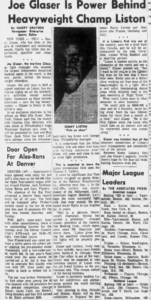
There is a hesitant form of critical labour that only becomes possible once admiration has settled—once the text has been allowed to unfold on its own terms and unveil what does not quite appear. In The Devil and Sonny Liston, this hesitation gradually takes shape around a name: Joe Glaser.
He is neither contested nor reinterpreted. As a matter of fact, he does not enter the narrative at all, absent from the story, from the index, and from the network of figures through which Tosches maps power. The absence holds, unannounced, provoking a disturbance in the field of attention that does not necessarily call for conclusion.
Joe Glaser is not what one would term a marginal figure. Contemporary press accounts describe him as “the power behind the heavyweight champion,” holding exclusive rights over Sonny Liston’s activities beyond the ring, including television and international exhibitions. He appears as a central broker—controlling contracts, shaping public appearances, structuring revenue streams, and mediating access to visibility itself. In another account, he is described as handling Liston’s “purse strings,” embedded in a broader network — The Chicago Outfit?—connecting boxing, entertainment, and capital. And yet, he does not appear.
The effect is difficult to localize. It is not the absence of information, but the absence of a node or of a point through which multiple relations might otherwise become legible. Without it, the network is bound to reorganise, if not to collapse.
The comparison that comes to mind is not one of omission, but of displacement: as if one were to read Aristotle without Plato—not incorrect, but structurally thinned, deprived of a relation that would otherwise reconfigure the whole. Paradoxically enough, even the documents that attest to Glaser’s role complicate this absence. They speak in a particular register: assertive, promotional, emphatic, at times self-justifying. Glaser appears as both manager and narrator of his own legitimacy—insisting that Liston’s “unsavoury connections” are “completely out of the picture,” while simultaneously consolidating control over his career. The voice is confident, expansive, at times curiously insistent.
This raises a different set of questions. Who is speaking here? To what extent can these accounts be taken as transparent records rather than mediated constructions? Is this an interview, or a performance of authority? And what kind of authority requires such visibility? If these documents are indeed treated as evidence, they risk stabilizing too quickly what remains uncertain. If they are treated as discourse, they begin to reveal something else: a competing narrative of power, one that operates through assertion, projection, and self-legitimation.
The absence of Glaser in Tosches’s text does not simply oppose the presence of these documents. It resonates with them. Both involve a management of visibility—one through omission, the other through alleged over-articulation. In this sense, the absence differs from a state of emptiness to become something more like a structured void.
Elsewhere in the book, the recurrence of “no one”—at times even rendered as Outis—suggests a language of strategic anonymity. The allusion to Odysseus naming himself “Nobody” to escape the Cyclops is difficult to ignore. But here, anonymity does not function as escape as much as it functions as condition: a way for certain figures to remain unlocatable within the narrative while still vigorously shaping its contours. Glaser occupies precisely such a position. Not hidden, but unassigned. Not erased, but uninscribed. Something akin to the prohibition against pronouncing the name of Elohim itself.
Within the broader mythological register of the book, this absence becomes even more legible. Liston is elevated—at times to leviathanic scale, at times to something more chthonic, Mephistophelean, aligned with the diabolical imagery of the title itself. This inflation is not neutral. It redistributes attention upward, toward figure, force, myth, hubris, and excess. What remains less visible nonetheless are the mediating structures through which such figures are produced, sustained, and circulated. At a certain point, the pattern becomes difficult to ignore. Myth does not replace structure; it displaces it.
The absence of Joe Glaser does not simply affect factual completeness in such an ambitious book. It participates in the reorganization of the narrative itself, thus leaving intact a world in which power appears as force rather than relation, and as destiny rather than arrangement. To attend to this absence is not to correct the text, nor to complete it. It means following one of its lines beyond where it chooses to stop.
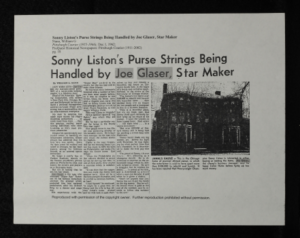
The second clipping is reproduced courtesy of the Louis Armstrong House Museum, New York, with special thanks to Ricky Riccardi.
V. The Persistence of Absence: Power, Archive, and the Duty of Disobedient Reading
What remains unsettled in The Devil and Sonny Liston is obviously not reducible to missing names or incomplete documentation. It concerns, on a broader scale, the very conditions under which certain forms of power become legible, while others recede.
Across the book, absence operates as structure: when Joe Glaser disappears, entire networks of mediation disappear with him. When Pearl Grayson is reduced to trace, violence loses duration. And when Muhammad Ali is rendered as spectacle, political agency becomes containable. Far from being isolated effects, they do belong to a broader organization of attention. Indeed, to write such a narrative is never neutral; every inclusion shapes visibility; every omission redistributes it. The question is not whether the text is accurate, but what kind of world it allows to appear. This raises a further question: can stylistic force alone be allowed to organize historical memory?
Tosches’s intelligence is not in doubt and never has been. It is precisely what gives the text its authority—and its gravity. But that same force generates its own hierarchy: what demands attention, and what can remain peripheral. Style does not merely describe power. It participates in its arrangement. At this point, the problem extends beyond the text itself.
The absence of Joe Glaser is not confined to Tosches’s narrative. In declassified FBI material relating to Sonny Liston, his name does not surface. A separate FOIA request concerning Joseph G. Glaser yields no accessible records. The point is not to suggest conspiracy, nor to replace analysis with suspicion. It is to register a convergence: a figure documented in journalistic sources, central to multiple networks of influence, appears simultaneously unlocatable within both literary narrative and institutional archive. This convergence does not resolve the absence. It thickens it.
The question becomes epistemological. What does it mean for a figure to disappear across different systems of record? What kind of knowledge is produced when absence itself begins to repeat? Reading, then, cannot be limited to what is present. It must also attend to what does not appear, to what remains unassigned, to what cannot be easily located within existing frames, bearing in mind that not every absence carries the same weight. Some are incidental, while others reorganize the whole field. Joe Glaser belongs to the latter.
His absence does not simply leave a gap. It preserves a certain configuration of the narrative—one in which power appears as force, personality, destiny, rather than as relation, mediation, or structure. His presence would not have added detail. It would have shifted the center of gravity, not least the style to carry it. This is where a different form of reading becomes necessary. One that follows the unresolved tensions of the text—beyond the point at which they are contained. A reading that does not relinquish admiration, but does not submit to it. It is also a reading attentive to what the text makes possible, and to what it makes difficult to sustain.
In this sense, the task is not to oppose Tosches, but to continue him—by taking seriously the very demand his work formulates: to look beneath surfaces, to distrust given narratives, and ultimately to attend to the operations of power even where they withdraw from view. Some absences ask, indeed, to be read.
CONCLUSION
By way of introduction, I traced Tosches’s epigraph back to Aeschylus’ Eumenides—to the chant of the Furies as they pursue Orestes. The line, rendered in Tosches in a slightly modernised form—“This is a song for the one who is doomed, a blow to the heart that breaks the mind”—corresponds closely to passages where the Erinyes describe their function as one of psychic persecution: a song of mental disintegration. A force that does not judge so much as it insists, returning again and again, refusing to release what has been set in motion.
Orestes is literally hunted/haunted into madness.
This context reframes the book. Violence is not simply narrated; it is made to reverberate, unresolved, uncontained, yet ever sustained—circulating as something closer to inevitability than to event. An archaic logic of inevitability, where the past does not pass, and where violence becomes indistinguishable from fate.
And yet, a tension remains.
If the Furies name a logic of relentless pursuit, the narrative at times appears to transform that pressure into something else: into rhythm, into image, into coherence, light and lyricism. What should remain difficult is, at moments, rendered legible. What should resist form is drawn into it. It is in that interval—between what insists and what is absorbed—that the reading takes place. Somehow, somewhere, perhaps near that bench, intent, if not to resolve or master the tension, at least on remaining with it, attentive to what persists and resounds on the one hand, and to what the text cannot fully hold on the other hand.
Perhaps the question is not only what may appear, but who—or what—distributes appearance itself. What governs what comes into view, and what remains in shadow? What allows certain figures to emerge, while others recede, or disappear altogether? Yes, somewhere around that bench.

Narjisse TDK Moumna is a Franco-Moroccan writer, curator, and translator based in Brussels. Her transdisciplinary practice moves at the intersection of archives, bodies, and power, across literature, performance, and curatorial research. Writing across languages and forms—essay, novel, poetry, translation, and editorial work—she develops a mode of reading attentive to what remains unsaid, displaced, or structurally obscured. Her work engages in particular with boxing as a cultural and political archive, exploring how figures are produced, mythologized, and erased within intersecting regimes of media, race, and power. This inquiry informs her doctoral research on the Senegalese boxer Battling Siki (1897–1925), tracing the colonial, transatlantic, and archival forces that shaped both his rise and his disappearance from historical narratives.
She previously directed the Spontaneous Art Museum in Brussels and continues to develop projects at the crossroads of archival research, writing, and exhibition-making.


