

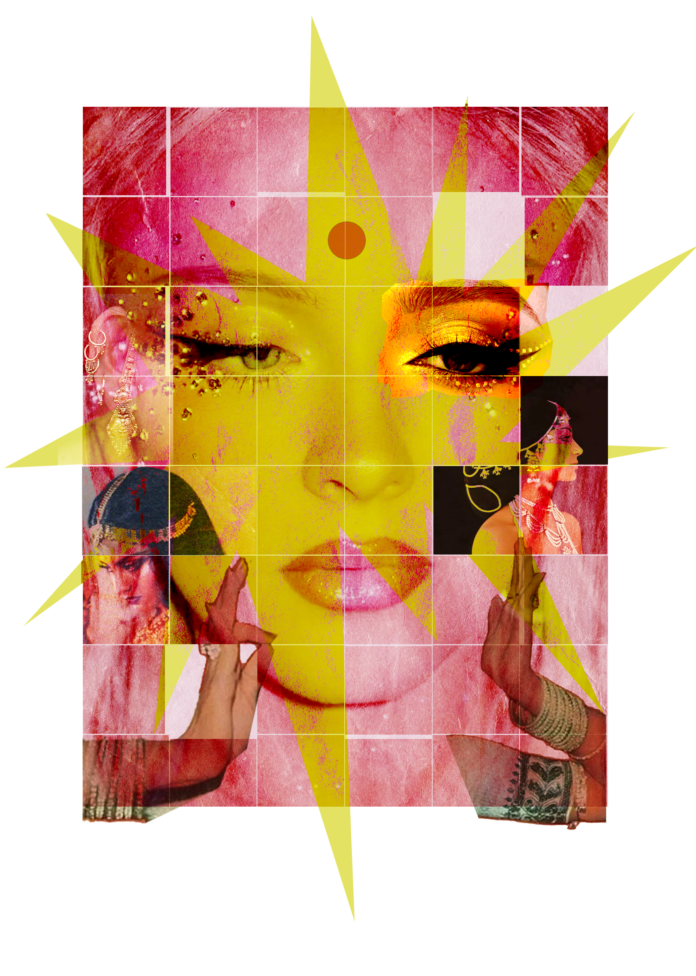
Somewhere in the internet’s collective imagination lives a place called the Khia Asylum—a metaphorical purgatory named after the rapper only known for one song, and a place where pop artists go when their relevance fizzles out but their career hasn’t quite caught up to that fact yet. Swedish pop star, Zara Larsson, had been a resident of this very asylum for quite a while. In 2025, she released Midnight Sun, and something shifted in her streaming numbers and more notably on every beauty corner of TikTok and Instagram. It wasn’t just her music that broke her out but also the makeup look she was seen sporting . Her makeup artist, Sophie Sinot, added sparkly rhinestones, bright coloured eye shadow, glitters and ‘summery’ costumes to her on-stage persona leading to what fashion editors would start calling ‘maximalist’ costuming.
The beauty industry’s response to this was immediate and breathless. Fashion magazines reached for the same word simultaneously, as if someone had sent a memo: rebellion. The consensus read something like this— after years of Minimalism ruling beauty culture (the so-called ‘Clean Girl’ era of slicked buns, barely-there blush, and the early retirement of the neon coloured eye-shadow palettes), Larsson had finally said no. A collective phrasing seemed to have emerged about Larsson’s maximalist look, “After years of minimalism dominating beauty trends, this feels like rebellion- colourful, chaotic and utterly unapologetic.” I’ve read that sentence umpteen number of times and yet I’m still not sure what it actually means. Rebellion against what, exactly? And more importantly, for whom?
If you happen to be a fellow South Asian, this is where the story stops adding up for us. The premise of this entire cultural moment, where Larsson and her makeup artist get credited for the fact that bold colour and ornamentation are making a comeback, only holds if you’ve been looking at a very specific slice of the world and calling it the universal opinion. South Asian visual culture, contrastingly, has never experienced a ‘minimalist’ phase since abundance had always been the norm. “When I look at India, I truly believe it is a maximalist country” , said world renowned designer Sabyasachi Mukherjee to The Voice of Fashion. “Even regions like Northeast or Kerala which are ostensibly minimalist, have spices, food and other ideas that are maximalist”. The South Asian cultural inheritance has evolved over millennia with craft and utility blending harmoniously with artistry. Alamkara, the Sanskrit term for adornment or embellishment, is practiced even today in the fields of art, music and poetry. While Western beauty discourse cycled through the “no-makeup makeup” of the 2020s and the clinical minimalism of the Clean Girl Era, South Asian weddings have continued to feature brides in elaborate jewelry sets—Nath, Maang Tikka, Jhumkas, layered necklaces, stacked bangles, all ornaments that would be considered absurdly maximalist by Western standards but are simply traditional requirements for the South.
As an Odissi (an Indian Classical dance form) dancer myself, the conversation around having to thank Zara Larsson’s PR team and stylists for bringing maximalism makeup back to the fore seems particularly laughable to me. I mean, it almost feels like my score-long tryst with extremely heavy, apocalypse-withstanding traditional make-up (the tutorials of which have been painstakingly bestowed upon me by my Odissi Guru) has vanished into oblivion from this perspective. I’m only one of the countless Indian traditional performers who would share this opinion. To explain just how deeply embedded this tradition of maximalist visual art in India goes, I can trace it back to around 200 BCE to a text called the Natya Shastra— essentially the oldest surviving treatise on performance, dramaturgy, and visual art in the world, compiled by the sage Bharata Muni. He was the first to recognise that colour influences the psychology and consciousness of a spectator and therefore colour should be thoughtfully considered in visual art forms. In Natya Shastra, Bharata Muni divided the visual arts into possessing four integral categories- Vachika, Angika, Aharya and Satwika Abhinayas. A traditional Indian classical dancer normally uses all the four forms of Abhinaya while performing onstage but it is the category of Aharya Abhinaya that lays special emphasis on the costumes and physical decorations of visual arts. Defined as the presentation of characters before the audience through the use of costumes, make-up and ornaments, this Abhinaya assists the dancer in depicting a character more effectively. In Kathakali, one of India’s most visually spectacular classical dance forms, the elaborate face painting alone takes two to four hours and follows a precise colour code—Pachcha (green) for nobility/gods, Kathi (green with red) for arrogant anti-heroes, Chuvanna Thadi (red) for evil, Kari (black) for primal demons, and Minukku (yellow/orange) for sages or women. This is followed so that the audience can read an entire moral universe from an actor’s face before the dance even begins.
The experience of watching something that has surrounded you your entire life get packaged as a revelation for an audience that previously found it excessive, foreign, or simply ignored it is a peculiar kind of whiplash. British Vogue’s article, Fashion As We Know It Wouldn’t Exist Without South Asian Style, wrote a tongue-in-cheek comment that accurately explains this confounding reality of today , “…you’ve got a small-eared elephant in the room: everyone wants a piece of India, but nobody wants to acknowledge it.”
Forgive me for insufferably bringing academic concepts into any and every conversation but, in my defense, Vogue Business says that being (or at least attempting to be) a bookish intellectual in today’s AI driven era is a countercultural, admirable quality. There’s a framework to explain the dilemma at hand today, and it comes from historian Dipesh Chakrabarty’s landmark book Provincializing Europe— a seminal postcolonial work if you want to understand how Western cultural authority operates on non-Western histories. Chakrabarty’s argument, stripped to its essentials, is this: European thought positions itself as the default timeline of human progress. Everything else from other histories to other cultures and ways of existing, is measured against it and found to be either catching up or left behind. He calls this ‘historicism,’ and he calls the place where non-Western cultures are perpetually held, the ‘waiting room’ of history: not quite arrived or modern, and always in the process of becoming what Europe already is. I’d argue that Western trend discourse operates exactly this way. When a fashion magazine declares maximalism “back,” it performs what Chakrabarty might call a kind of temporal violence- asserting that their own aesthetic cycles are the universal calendar, and that everything outside those cycles either don’t count or don’t exist until it’s been named and validated inside them. In that context, “When did maximalism leave?” ends up becoming a truly Chakrabartian question. It exposes that someone, somewhere, claimed the authority to announce its departure and that this announcement was treated as global fact, despite having no relationship to the aesthetic realities of the majority of the world. Considering the West to be more self-centred than my ex wouldn’t be an exaggeration at this point.
Coachella 2026 gave us the most literal version of this dynamic I’ve seen in recent memory, and I say this as someone who spent an embarrassing amount of time down that particular internet rabbit hole. The music festival became popular, particularly across South Asian media, for what got nicknamed Desichella: the phenomenon of South Asian influencers arriving in Jhumkas (traditional Indian drop earrings), Dupattas (long draped scarves that was most recently touted to be ‘scandinavian’), and Mehendi (henna hand art), and being celebrated for it as a bold, intentional fashion moment. ThePrint wrote in their article, ‘Indian influencers reclaim desi aesthetics at Coachella’ , framing it as Indian influencers “reclaiming” and bringing about, “a quiet revolution in festival dressing.” And I want to be fair here: there is something genuinely moving about seeing aesthetics you grew up with get treated with seriousness on a stage that large. I’m not immune to that. But I do keep getting stuck on the mathematics of it. South Asian women have been wearing these exact aesthetics in their own communities, at their own weddings, festivals, and celebrations, for generations. Not as costumes but just as a regular Tuesday. For decades, those same aesthetics worn in those same communities were not legible as fashion. They were the thing well-meaning Indian aunties and uncles would ,based on their own experiences, quietly advise you to tone down on if you wanted to be taken seriously in Western spaces. Yet, the only thing that changed this time was the postal code. I see a glaringly obvious irony in the fact that the ‘revolution’ requires Western spatial validation to exist in the first place.
This is where the logic of Chakrabarty’s ‘waiting room’ appears. It isn’t just that South Asian aesthetics had to wait to be validated, it’s that the validation required a very specific geography. The practice had to be physically relocated: lifted out of the South Asian communities where it had lived continuously, and restaged at one of the world’s most expensive, most visible Western pop-culture music festivals. It also couldn’t have been just anyone who would do the restaging. It took NRI influencers—Non-Resident Indians, people who code-switch between South Asian and Western cultural registers with practiced fluency, to make the aesthetic more palatable and intentional.
The recognition earned at Coachella is real, but it is also crucially unstable. ‘Desicore’ — a new aesthetic term about “owning and not just wearing” your desi roots is already being packaged as a trend. And trends, by definition, have an expiry date. The same machine that declared maximalism “back” will, on its own schedule, declare it over. The continuous cultural practices of an Indian grandmother’s stashed jewelry box being passed down to her granddaughter, of the fanfaring wedding trousseau, and of the classical dance studio don’t operate on this calendar. It is safe to say, they never did. A trend cycle however, will mine the aesthetic, exhaust it only to move on once it’s been wrung dry and when it does, South Asian adornment will be returned to the waiting room once again. Until the next festival, influential face or the next season decides it’s relevant again.
When a South Asian girl like me, sitting in her Nani‘s living room, is staring at her phone in bewilderment at the empty praises of ‘maximalism revival‘ by Zara Larsson’s team, the confusion feels all the more pertinent as I ask “When exactly did maximalism leave?” The answer, it turns out, is that it never did, especially not from the jewelry boxes. The real question that lies at hand is therefore not when maximalism left, but who claimed the authority to say it had gone in the first place, and why millions of people accepted that declaration despite the evidence glittering on their own wrists. The viral sensationalisation of ‘Indian maximalism’ was not about bringing adornment back as much as it was about Western cultural authority finally catching up to practices that never needed their permission to continue. There is a peculiar genius in continuous practice, it lies in the fact that it does not require validation to exist. Somewhere, a grandmother is choosing the most heavily embroidered saree to pass down to her descendants and in a classical dance studio somewhere, the technical vocabulary of Aharyabhinaya is being transmitted to someone who may never use the Sanskrit term but will apply its logic every time they dress. These practices will outlast the trend cycle that just claimed to have invented them and they shall persist through maximalism’s inevitable next “departure.” Safe to say, I’m glad that Zara Larsson is climbing the successful pop-star ladder, but maybe, instead of celebrating which celebrity’s makeup artist gets credited each season, we’d do better to ask what it would mean to finally escape the waiting room ourselves and simply be the colourful, layered, zardozi-draped communities we have always been.
Srijoni Nandi is a Junior Editor at ALMA Magazine. She writes fiction and essays at the intersection of postcolonialism and the performing arts, drawing from her own life as a professional Odissi dancer and literature student.


